Red Chilli Pickle: South India’s Boldest Condiment Is Having a 2026 Moment

Introduction :

Red chilli pickle is the most underestimated condiment in the Indian kitchen. For years, it was treated as a side-shelf item, something your aunt kept in a small steel dabba for visiting relatives. Then, quietly, it became the fastest-growing pickle sub-category in the world. Mordor Intelligence’s 2026 industry report lists red chilli pickle and chilli-based pickles as the segment growing at 9.8% CAGR globally, ahead of every other pickle variant.What changed? A younger Indian palate rediscovered it. Export demand from the Middle East and the UK surged. And home cooks began experimenting with it as a layered finishing condiment rather than a blunt heat source. Red Chilli Pickle
Red Chilli Pickle Is Not a Single Thing:

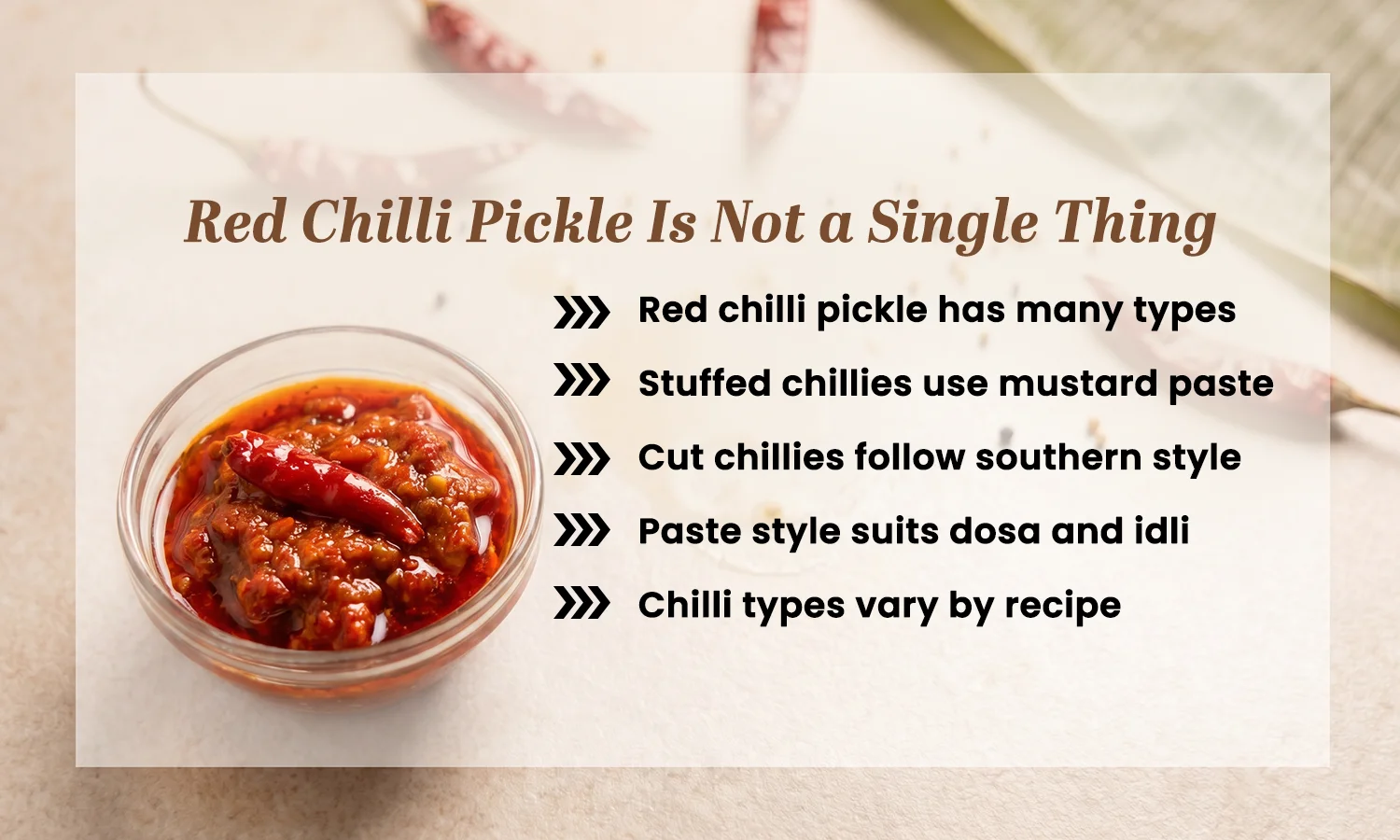
This is the confusion that most people have when it comes to Red Chilli Pickle being the only variety. When shoppers search for red chilli pickle, red chilli for pickle, or lal mirch pickle, they could mean three entirely different products:

  • Whole stuffed red chilli pickle: Fat red chillies (Bhavnagri or similar), slit and stuffed with a mustard-fenugreek-turmeric paste. It is usually northern style with a lot of oil.
  • Cut red chilli pickle: Smaller red chillies chopped into segments, fermented with lemon juice or vinegar. It’s southern and Telangana style.
  • Red mirchi pickle (paste-style): A smooth red-chilli-based paste, almost a pickle-chutney hybrid. It goes with dosa, idli, and chapati.

So based on the above, each uses a different chilli variety. The search term red chilli for pickle often brings up whole chillies specifically meant for stuffing: Byadgi, Bhavnagri, and Guntur being the three most common. These are distinct from the chilli powder category entirely.

Why Chilli Pickle Is Surging in 2026

Three structural shifts are worth noting:

  • Gen Z palate recalibration. A 2025 YouGov India survey showed that 62% of consumers aged 18-28 prefer higher heat levels than their parents’ generation, a reversal of the “milder, healthier” trend that dominated 2010-2020.
  • Export pull. The UK and GCC markets drove a 34% year-on-year increase in Indian chilli pickle exports (APEDA, FY 2024-25).
  • Functional positioning. Capsaicin research has made chilli “healthy heat” in a way plain mustard or salt cannot claim. Capsaicin’s metabolic and appetite-regulation links, while still being studied, are becoming mainstream talking points.
Red Chilli Pickle

Green Chilli and Green Pepper: The Cousins Worth Knowing

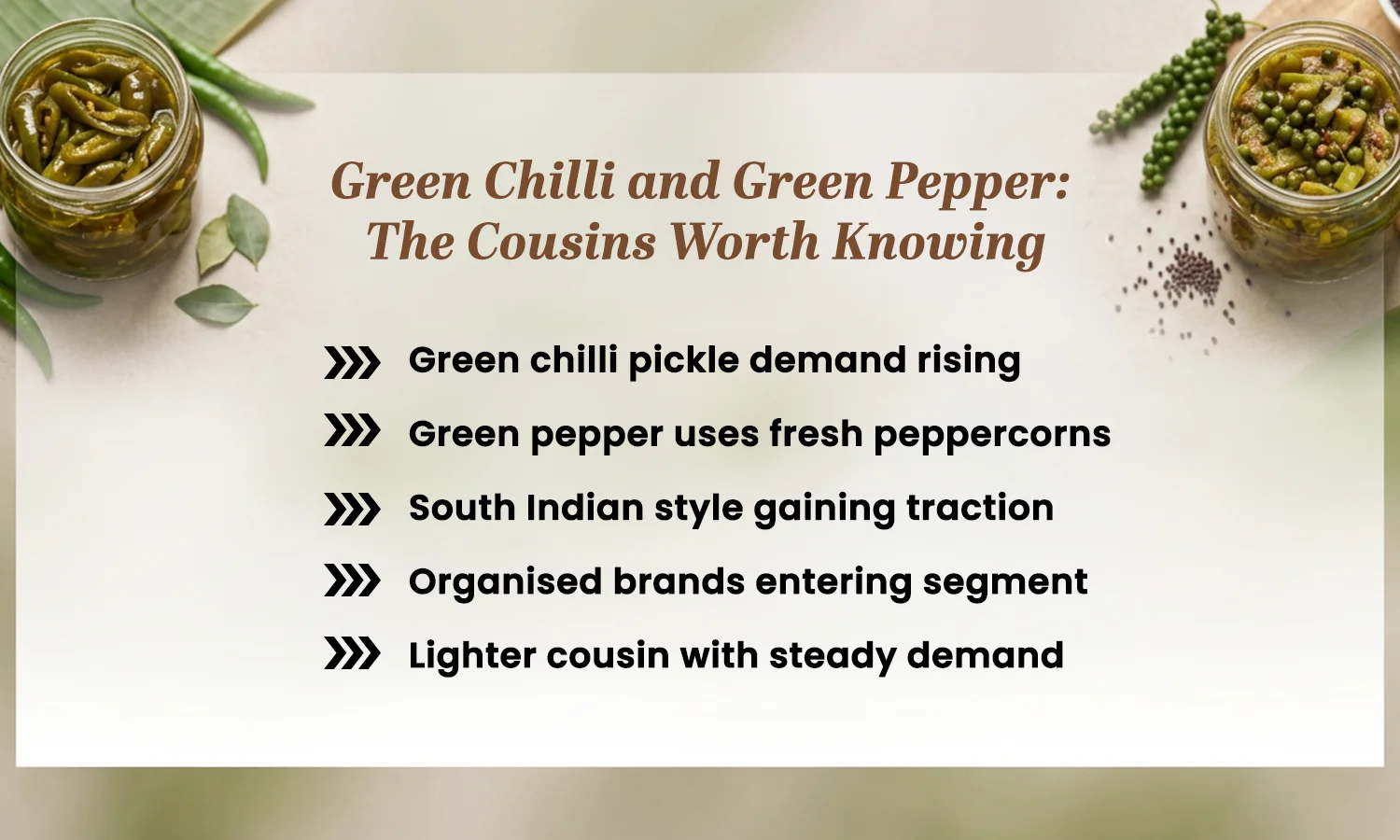
Red is the headline, but green has its own following. Green chilli pickle online searches have doubled in the last two years, and so has demand for green pepper pickle, the South Indian version made with fresh green peppercorns, not bell peppers. The SGR 777 Spicy Green Pepper Pickle 300g is one of the few organised-brand expressions of this style in the Indian market. Green chilly pickle, a lighter cousin, is also seeing steady shelf demand.

Pricing: What to Expect

The chilli pickle price range in organised retail is narrower than that of mango pickle, typically ₹100 to ₹180 for a 300g jar, because the ingredient cost profile is more predictable. Chilli, as a raw material, does not have the seasonal price swing that mango has. That makes chilli pickle a good recurring-purchase SKU for households looking to stabilise pantry spend.
For buyers searching specifically for red chilli pickle online or red chilli for pickle online, pricing transparency matters. Look for brands that disclose oil type (gingelly, mustard, or refined), chilli variety (Guntur, Byadgi, Bhavnagri), and the grind style (whole, split, or pasted).

How to Use Red Chilli Pickle Without Overdoing It

Chilli pickle has a reputation for being aggressive. Used correctly, it is the opposite, a finishing accent. Four practical applications:

  • Quarter-teaspoon as a curd-rice contrast.
  • Thin spread on a warm paratha replaces butter in some Punjabi homes.
  • Folded into dosa batter (small amount) for a spiced variant.
  • On top of a masala omelette, the oil layer merges with the egg and delivers depth without dominating.

Buying Red Chilli Pickle Online: What to Look For

Three markers separate a genuine chilli pickle from a filler-heavy one:

  • The chilli should be visible, not lost in the paste. A good chilli pickle shows you the ingredient.
  • The oil should coat the chilli evenly, not pool separately at the top.
  • The aroma on opening should be of chilli and gingelly/mustard oil, not vinegar-sharp.

Explore chilli and pepper pickles in the SGR 777 pickle range: bold, traditional, and made in Chennai since 1954.

FAQs

What Is the Difference Between Red Chilli Pickle and Red Chili Pickle?None, it is a spelling variation. “Chilli” is British/Indian English; “chili” is American. Both refer to the same category.
Which Chilli Variety Is Best for Pickles?For whole stuffed pickles, Bhavnagri or larger Byadgi chillies. For cut chilli pickle, Guntur works well due to its colour and heat balance. For red mirchi paste-style, Byadgi is preferred for its deep colour without extreme heat.
Is Green Pepper Pickle the Same as Green Chilli Pickle?No. Green pepper pickle uses fresh green peppercorns, the same plant that gives black pepper. Green chilli pickle uses fresh, unripe chillies. Different flavour profiles, different culinary uses.
Can I Order Red Chilli Pickle in Bulk for Commercial Use?Yes. 777 Foods offers bulk chilli pickle packs for caterers, hotels, and cloud kitchens. Contact the brand trade desk for per-kg pricing.
Pickle Shop Near Me: The 2026 Guide to Buying Pickles Online and Offline

Summary

A 2026 guide to buying pickles online and offline. Explains why “pickle near me” searches grew 180–220% (urbanisation, quick commerce habit, regional preferences) and maps the five buying channels: brand D2C, quick commerce, modern trade, general trade, B2B. Covers improvements in packaging, delivery speed, and freshness transparency, plus tips to search smarter and decode “homemade-style” labels.

Introduction :

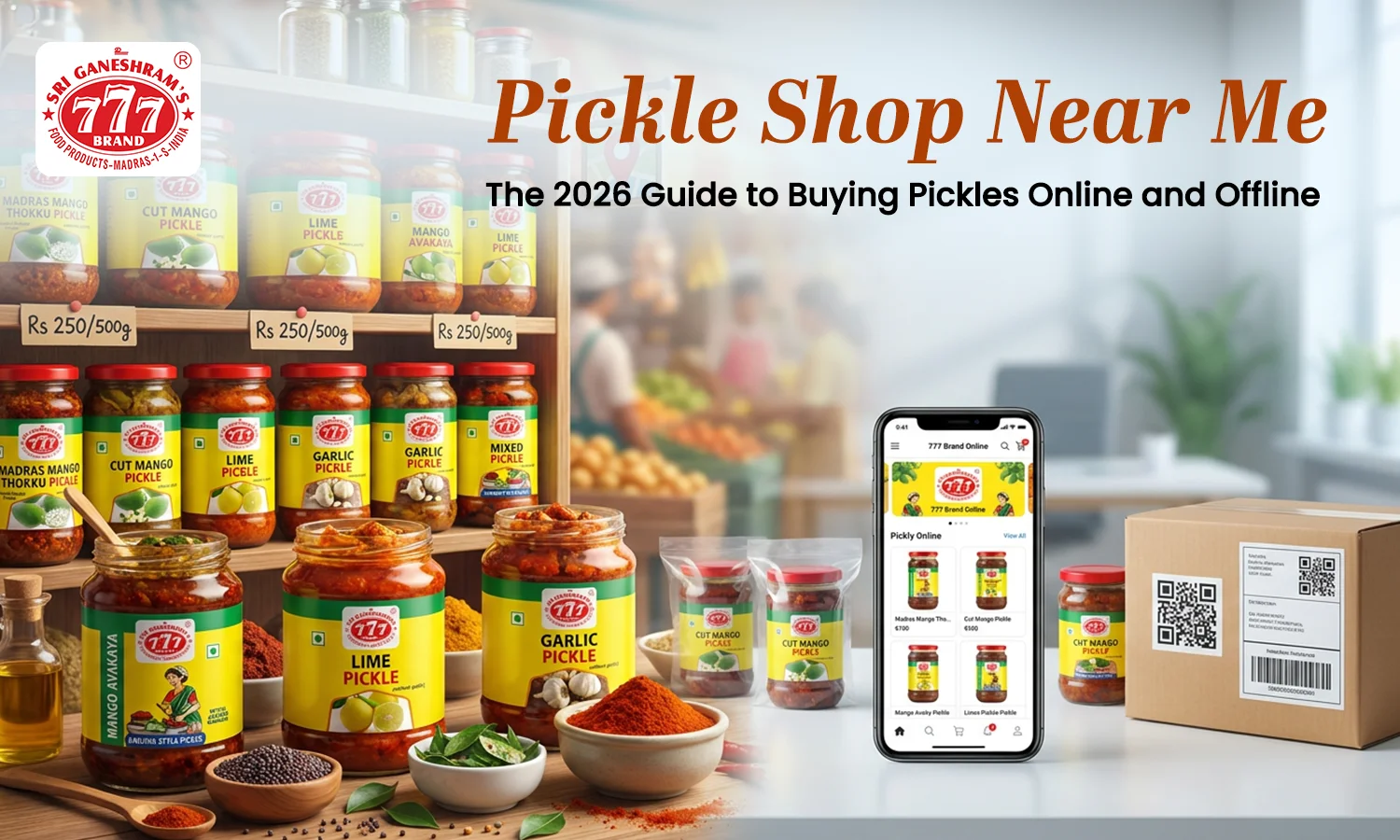
Five years ago, the default way to buy a pickle in India was a kirana shop, a family shelf at home, or an occasional online order that took a week. In 2026, the picture has changed completely. Now it’s like a shopper typing pickle shop near me on a Sunday evening, and expecting the jar in their kitchen within sixty minutes.
Quick commerce, such as Blinkit, Zepto, Instamart, BigBasket Now, and Swiggy Instamart, has rewritten the pickle supply chain entirely. Brands that were built for two-week distribution cycles have had to rebuild for ten-minute ones. That shift is worth understanding, whether you are a household shopper, a dealer, or a retail buyer.

Why “Pickle Near Me” Searches Grew 3x in Two Years

Google Trends data for pickle near me and pickle store near me shows sustained growth of roughly 180-220% between 2024 and early 2026 in urban India. Three drivers explain it:

  • Nuclear-family urbanisation. Homemade pickle, the traditional fallback, is declining. Packaged pickle purchases through local shops and apps have replaced the summer-jar ritual in most metros.
  • Quick commerce habit formation. Once a shopper uses Blinkit for pickles twice, the third purchase is automatic.
  • Regional search preference. Shoppers increasingly search for local styles, “pickles Hyderabad” for avakaya, “Kerala pickles online” for fish-free curry leaf variants.

The Five Channels a Pickle Shopper Actually Uses

A 2026 NielsenIQ retail audit identified five dominant channels for packaged pickles in India. Understanding which one fits you saves 20-30% on average cost:

  • Brand D2C: Shopping directly at the brand’s website. It has the best price and the widest range. 777 Foods offers free shipping above ₹300 and a first-order discount on its catalogue.
  • Quick commerce: These are the 10-minute delivery apps. Narrowest range (usually 5-8 SKUs per brand), convenience premium of 8-15%.
  • Modern trade: These are the supermarkets and hypermarkets. These have full visibility and frequent promotional pricing across all media.
  • General trade: Our local kirana and provision stores. Best for established SKUs like garlic and mango pickle.
  • B2B and institutional: Bulk packs for caterers, cloud kitchens, and hotels. Lowest per-100g rate.

Buying Pickles Online: What Has Improved Since 2026

Buying Pickles Online: What Has Improved?

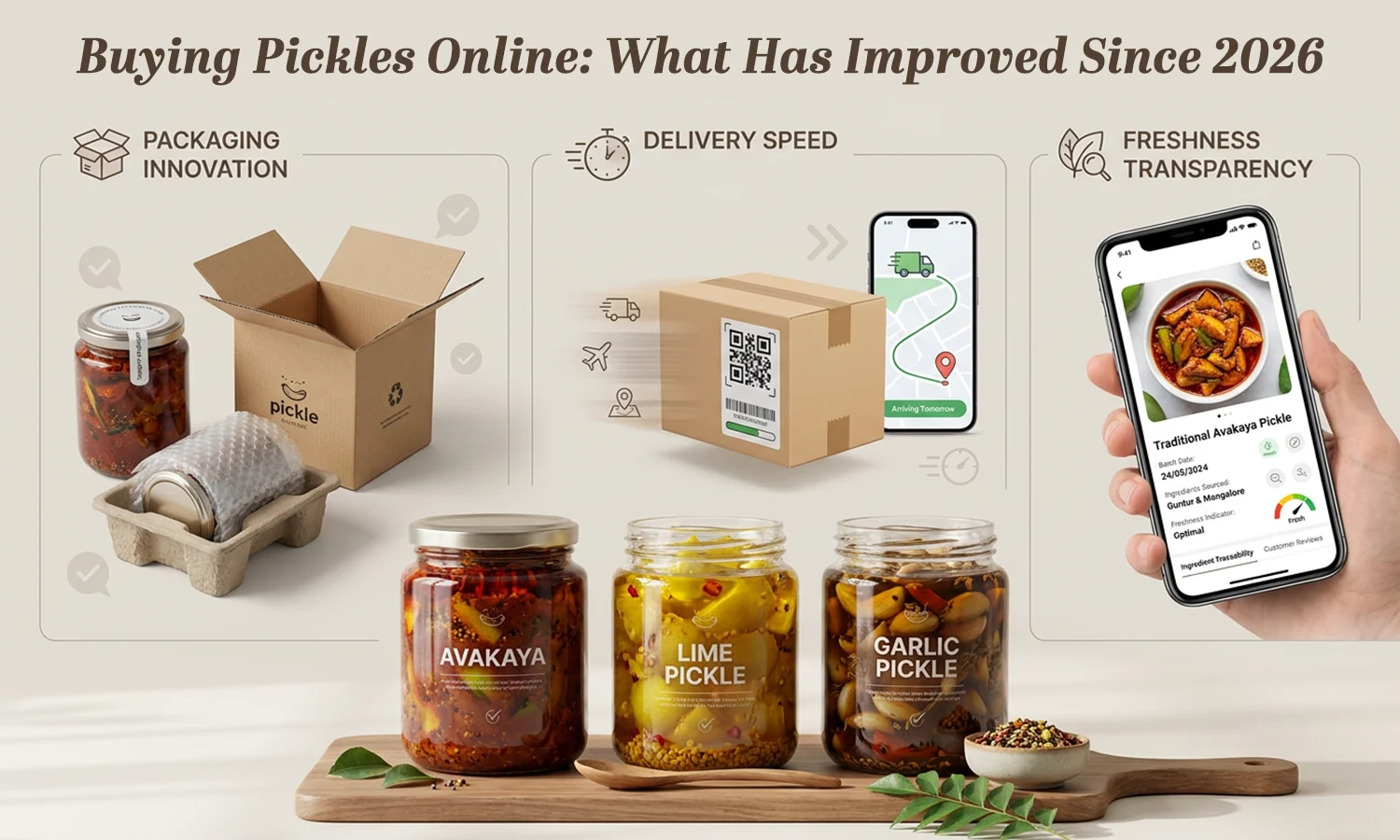
For readers buying pickles online in 2026, the experience is measurably better than two years ago on three counts:

  • Packaging. Double-sealed caps and oil-lock liners have cut transit leakage by approximately 70% across major brands (All-India Food Processors Association, 2026).
  • Delivery speed. Median delivery for D2C pickle orders in metro India is now 36-48 hours. Quick commerce delivers in under 60 minutes.
  • Freshness transparency. Most organised brands now print the packing date alongside expiry. 777 prints both, plus a recommended consumption window.

The common search terms that bring buyers here, pickles online order, pickle online order, pickle online shopping, online pickles, buy pickles online, all point to the same underlying need: a reliable jar, delivered fast, priced fairly.

How to Search Smarter for Pickle Online

Here are a few practical tips that we could use:

  • Search by style, not just category. “Andhra avakaya pickle 300g” returns fewer, better results than “pickle.”
  • Filter by origin city. Pickles made in South India ship faster to South Indian addresses.
  • Check the packing date, not only the expiry. A pickle that sat for four months in a warehouse loses freshness even if unopened.
  • Read the ingredient list for oil type. Gingelly oil is the South Indian benchmark; refined palm is a shortcut.

The common search terms that bring buyers here, pickles online order, pickle online order, pickle online shopping, online pickles, buy pickles online, all point to the same underlying need: a reliable jar, delivered fast, priced fairly.
Homemade-Style Pickle Online

Homemade-Style Pickle Online: What the Label Actually Means

The phrase, homemade pickles online, has become a category unto itself, with shoppers explicitly searching for the best homemade pickles online.

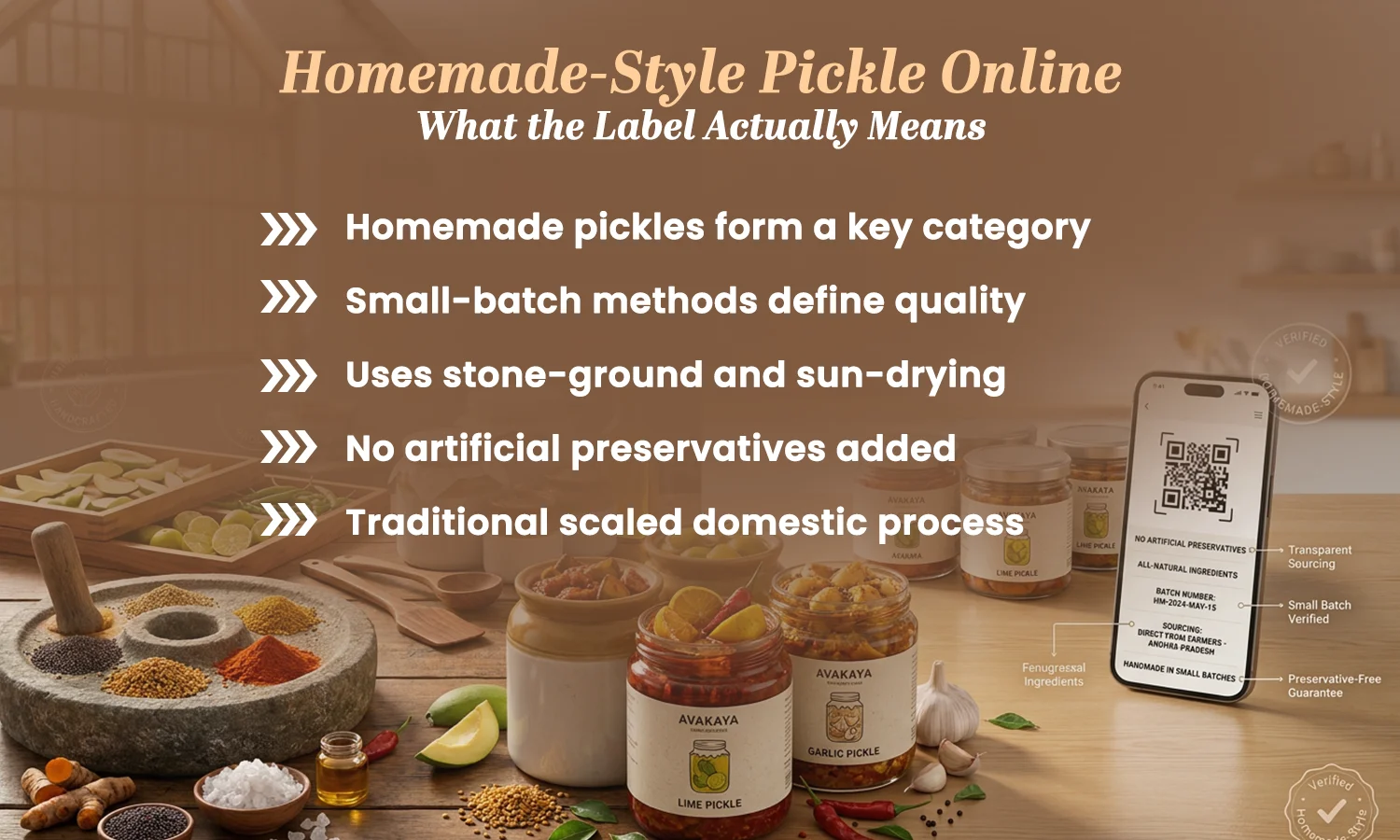
A genuinely homemade-style pickle is one that uses domestic-scale production methods, small batches, stone-ground spice, sun-drying, and no artificial preservatives. It does not mean the pickle was literally made in someone’s home.
777 Foods’ pickle range sits in this category. The brand has been making traditional South Indian pickles from its Mylapore, Chennai kitchen since 1954, using domestic-scale methods scaled up, not factory-scale methods scaled down. That is the distinction most buyers searching for homemade-style quality are actually trying to find.

Where 777 Fits in the Local + Online Map

For shoppers in Chennai, Bangalore, Hyderabad, Coimbatore, and Kochi, 777 pickles are available through:

  • Brand website: sgr777foods.com with pan-India delivery.
  • Amazon and Flipkart; full catalogue.
  • Quick commerce: select SKUs on Blinkit, Zepto, and Instamart.
  • Modern trade: Reliance Smart, Nilgiris, More Supermarket, and regional chains.
  • General trade: thousands of kirana and provision stores across South India.

Order the complete range from sgr777foods.com/pickles. With pan-India shipping and packing date printed, your jar arrives with the oil layer intact.

FAQs

Is There a Reliable Pickle Shop Near Me That Stocks 777?

Yes, across South India. The brand is sold through kirana outlets, provision stores, and modern trade chains in Tamil Nadu, Karnataka, Andhra Pradesh, Telangana, and Kerala. For exact stockists, the brand’s website has a store locator.

Which Platform Is Cheapest for Buying Pickles Online?

The brand’s own website is usually the cheapest, because it avoids platform margins. First-order discounts and free shipping above ₹300 apply on 777 Foods.

Can I Get a Pickle Delivered in 10 Minutes?

Yes, in most metros. Select 777 SKUs are listed on Blinkit, Zepto, and Instamart. The catalogue on quick commerce is narrower than on the brand website.

Are Kerala-Style Pickles and Hyderabad-Style Pickles Available Online?

Yes. The 777 Foods catalogue covers Tamil, Kerala, and Hyderabad/Andhra styles. Shoppers searching for pickles, Hyderabad, or Kerala pickles online can find authentic regional variants on the brand site.

Rose Syrup Beyond Rose Milk: 10 Desserts and Drinks You Can Make in 5 Minutes

Summary

Ten five-minute uses for rose syrup beyond rose milk: classic rose milk, water-based rose sharbat, rose kheer, milkshake, falooda, lemonade, lassi, ice-cream drizzle, rose-soaked fruit salad, and a tonic-based rose mocktail. Explains why consistency of a thick traditional syrup matters across hot, cold, and dessert applications, and advises refrigerating opened bottles for 30–45 day freshness.

Introduction :

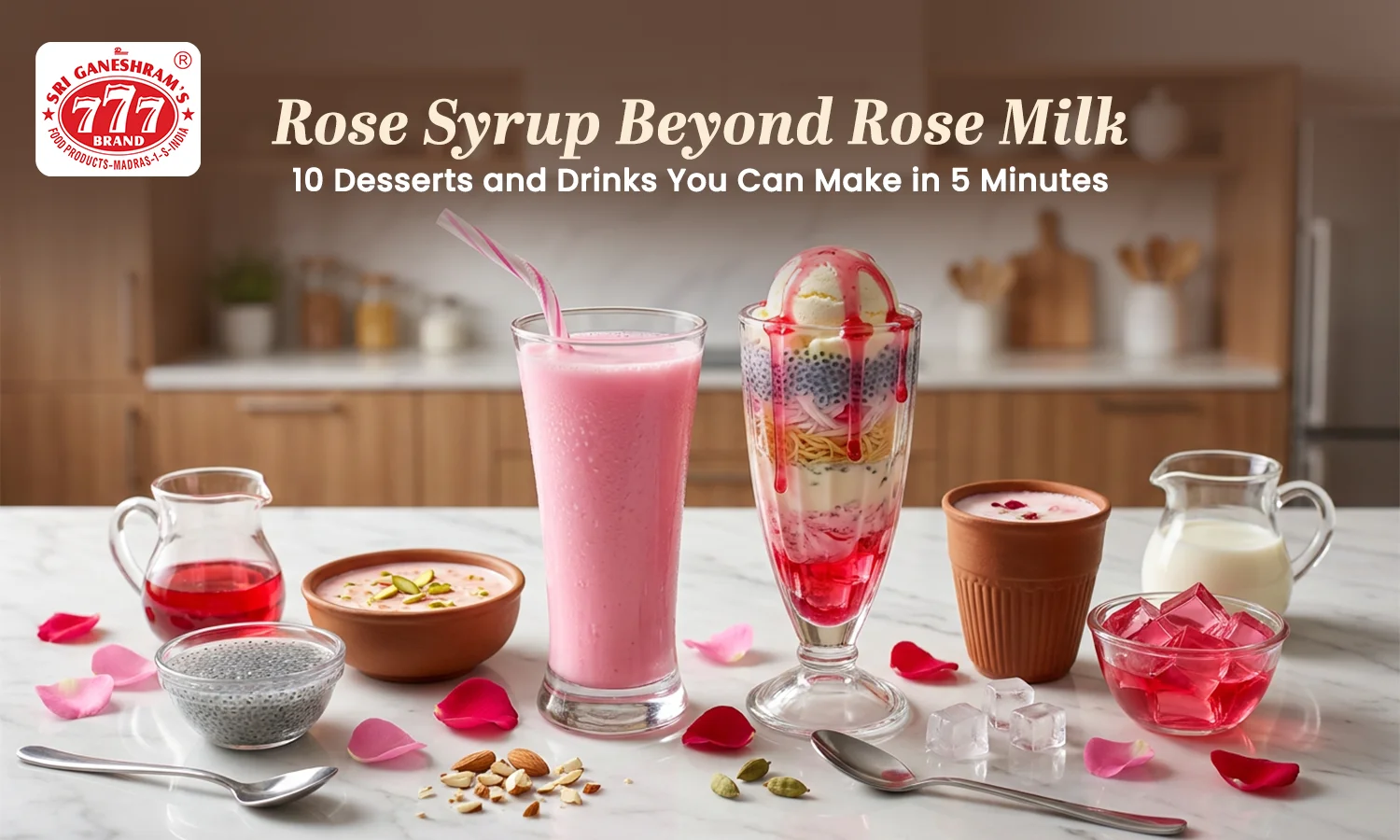
A bottle of rose syrup is the most underused ingredient in the average Indian kitchen. Most households open it for one reason, rose milk, and then return it to the shelf for another fortnight. That is a waste of a genuinely versatile ingredient. The uses of rose syrup stretch well beyond the classic pink glass.Here are ten five-minute ideas that rotate one SGR 777 Rose Syrup bottle across your entire summer. Rose syrup

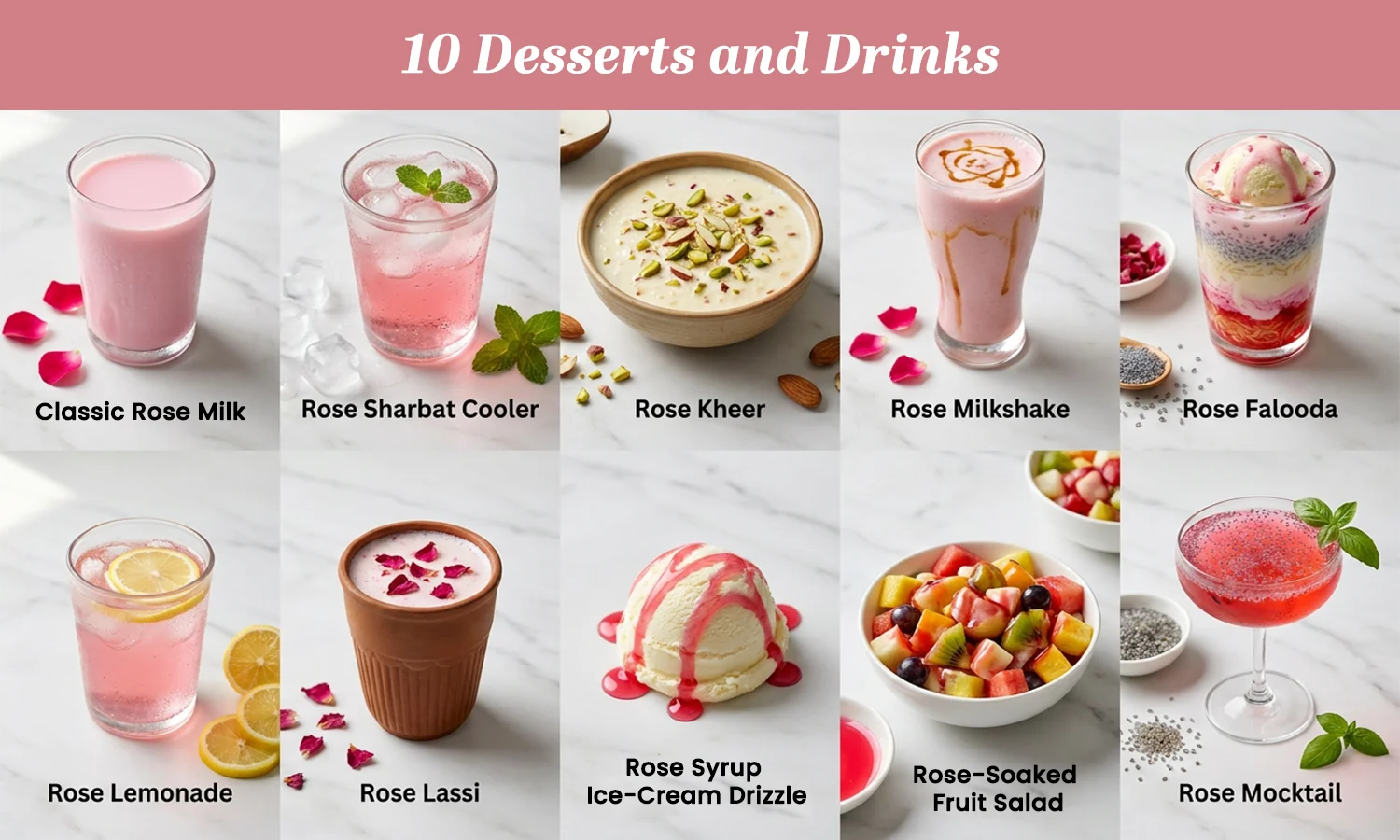
1. Classic Rose Milk

The default: 2 tbsp SGR 777 Rose Syrup, 250 ml chilled milk, ice, a dust of cardamom. A rose milk mix scaled up for family gatherings works perfectly; the syrup holds its ratio beautifully at volume.

2. Rose Sharbat Cooler

The water-based version. Rose syrup + chilled water + lime + sabja seeds + ice. Lighter, faster, and fasting-friendly. The rose sharbat recipe is genuinely a two-minute operation.

3. Rose Kheer

Make your regular kheer, rice, milk, sugar, and cardamom. In the last minute of cooking, stir in 2 tbsp SGR 777 Rose Syrup. The rose kheer turns a faint pink, smells like a garden, and earns compliments it does not really deserve for the effort involved.

4. Rose Milkshake

Blend 250 ml milk, 2 tbsp rose syrup, 1 scoop vanilla ice-cream, and ice. The rose milkshake is the drink your children will ask for every Friday evening. Add a handful of fresh strawberries in peak season for a restaurant-grade finish.

5. Rose Falooda

Layer 2 tbsp rose syrup for falooda at the bottom of a tall glass. Add soaked sabja seeds, cooked falooda vermicelli, chilled milk, a scoop of vanilla ice-cream, and top with chopped nuts. Five minutes if you have the components prepped.

6. Rose Lemonade

Sparkling water, lime juice, 2 tbsp rose syrup, mint leaves, and ice. A drink that photographs beautifully and drinks even better. The most underrated modern use of a bottle of rose syrup.

7. Rose Lassi

Blend 200 ml thick curd, 2 tbsp rose syrup, a splash of milk, ice, and a pinch of cardamom. A Punjabi-meets-Persian classic that is both cooling and filling. Excellent as a late-afternoon mini-meal.

8. Rose Syrup Ice-Cream Drizzle

Vanilla ice-cream, a generous drizzle of rose syrup, crushed pistachio, and a pinch of edible rose petals. Thirty seconds to plate. Hotel-standard dessert. This is rose syrup doing its most glamorous job.

9. Rose-Soaked Fruit Salad

Chop apples, grapes, pomegranate, and pineapple. Toss with 3 tbsp rose syrup, a squeeze of lime, and a pinch of rock salt. Chill 15 minutes. The fruit absorbs the rose and releases its own juices; the result is astonishingly grown-up.

10. Rose Mocktail

Muddle mint and lime in a copper tumbler, add 2 tbsp rose syrup, top with tonic water and ice. Five minutes. Twelve compliments. Pair with roasted cashews. Parties end too fast with this one.

Why One Bottle Does Everything

The reason SGR 777 Rose Syrup works across all ten uses is consistency. A good traditional rose syrup carries its own body, aroma, and balanced sweetness, meaning it behaves identically whether you stir it into hot kheer, blend it into a milkshake, or drizzle it over ice cream. A thin essence or an inconsistent syrup will betray at least three of the ten recipes above. This is why quality at the source matters.

A Note on Storage

Refrigerate an opened rose syrup bottle. Close the cap tightly after every use; volatile compounds escape at room temperature. A bottle stored correctly maintains flavour for 30–45 days after opening. Making rose syrup at home is possible, but it is a multi-day petal-and-sugar process, and the consistency is hard to replicate. Starting with a ready bottle is the sensible choice for 99% of households.

FAQs

Can Rose Syrup Replace Sugar in Desserts?

Partially. Rose syrup adds sweetness plus aroma, so reduce the recipe’s sugar proportionally. It cannot fully replace dry sugar in baking structures like cakes.

Which Rose Syrup Works Best for Falooda?

A thick, traditional rose-petal syrup like SGR 777 Rose Syrup, the body holds at the base of the glass and flavours each layer as you drink.

Can I Use Rose Syrup in Tea or Coffee?

In iced rose-milk-tea preparations, yes. In hot coffee, the aroma evaporates, and the effect is lost.

Traditional Indian Summer Drinks: A Regional Map from Kerala to Kashmir

Summary

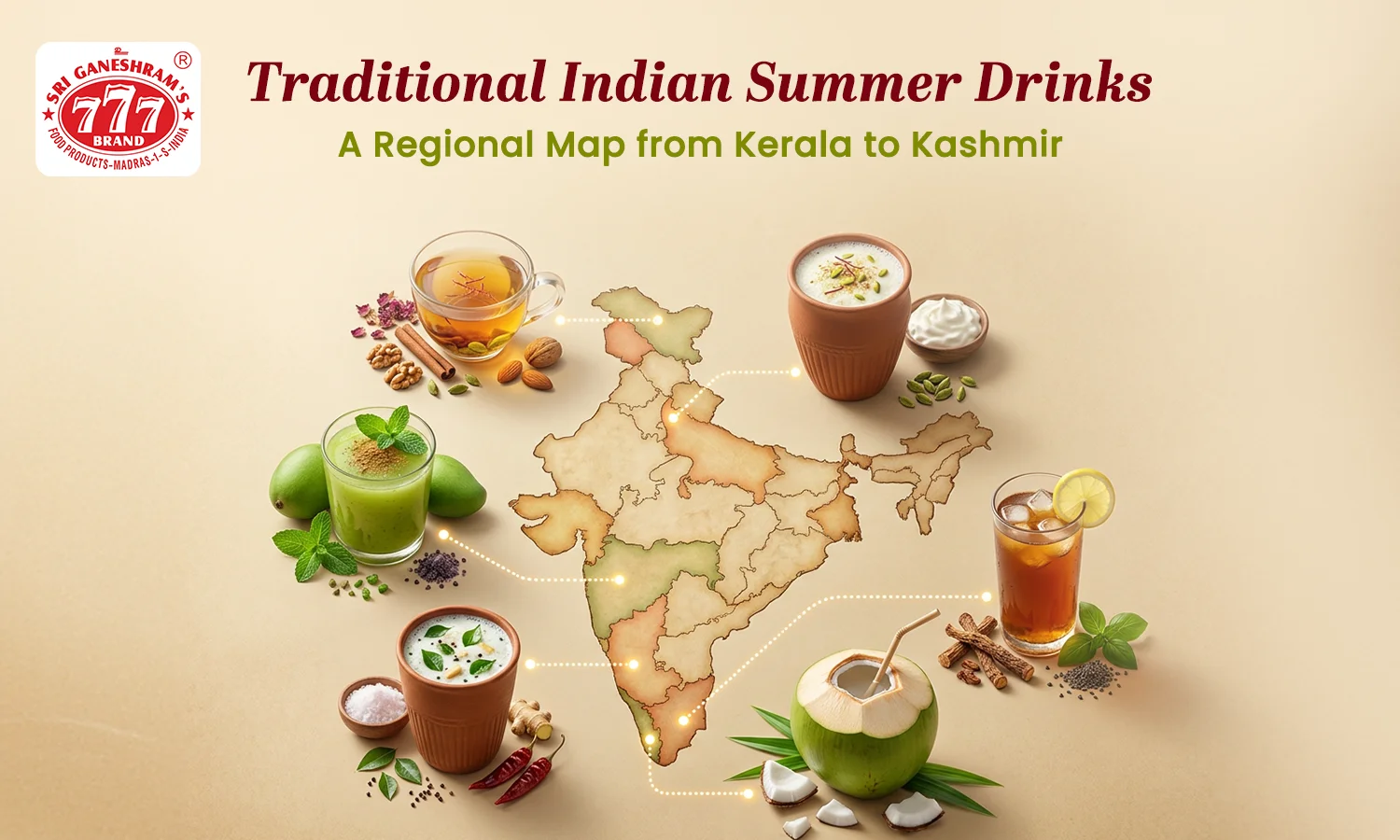
A regional map of India’s traditional summer drinks: South (nannari, rose, paanagam, neer mor), West (kokum, aam panna, chaas), East (bel sharbat, gondhoraj lime, aam pora shorbot), North (rooh afza, thandai, khus, shikanji), Kashmir (cold noon chai), and Central (sattu). Cites a 23% YoY volume rise in traditional syrups and explains the universal concentrate+water+acid+salt formula.India is probably the only country in the world that has a distinct summer drink for almost every state. Before carbonated soft drinks colonised the supermarket aisle in the late 20th century, every Indian region had already solved the heat with its own sarbath drink, sherbet, or cooler, each rooted in local botany, local climate, and local ritual. This is a regional map of the traditional sarbath juice heritage that is, happily, making a strong comeback in 2026.
Summer Drinks

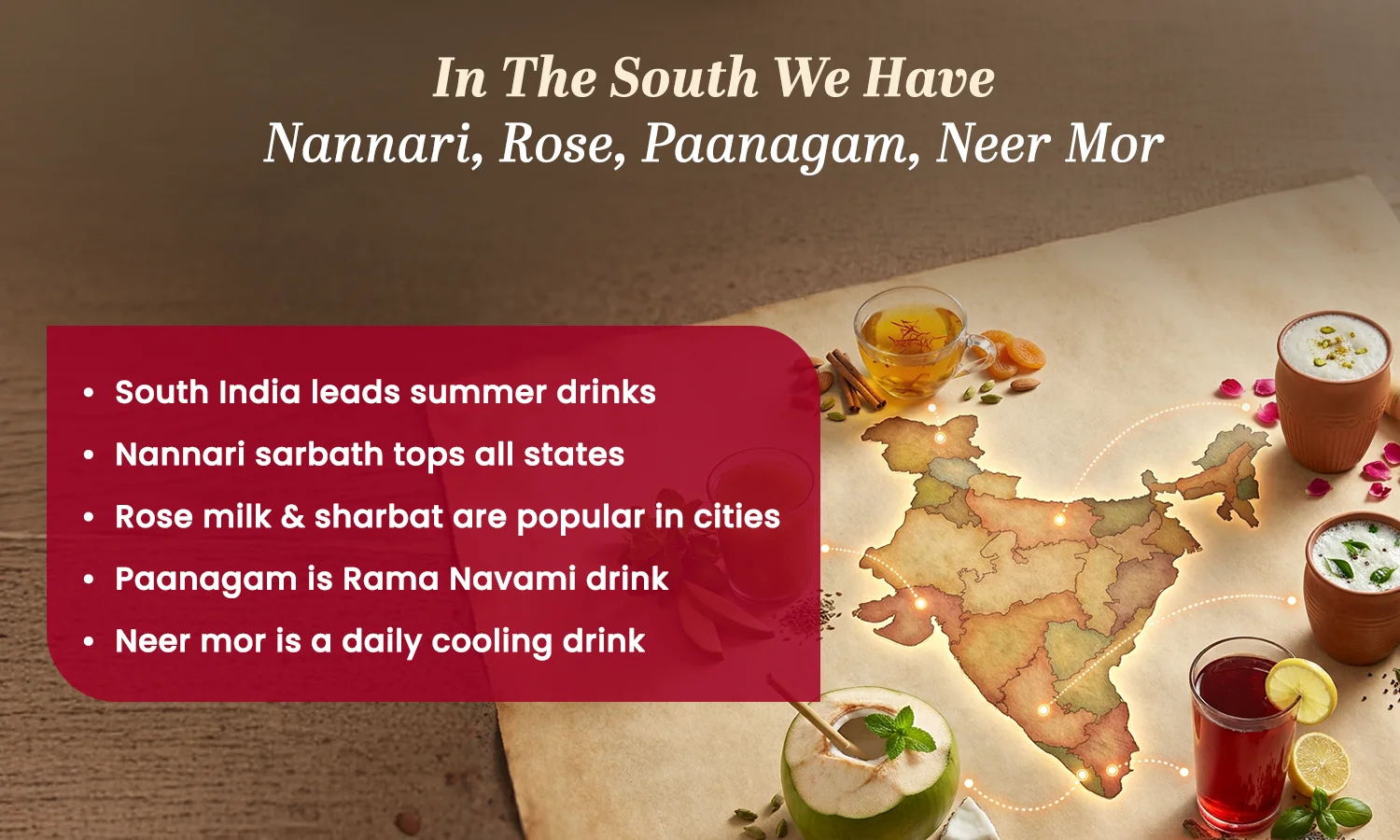
In The South We Have: Nannari, Rose, Paanagam, Neer Mor

South India is the undisputed capital of traditional summer drinks. Nannari sarbath, the Indian Sarsaparilla cooler, leads the category across Tamil Nadu, Kerala, Karnataka, Andhra Pradesh, and Telangana. Rose milk and rose sharbat dominate the urban sarbath stall circuit from Chennai to Bengaluru. Paanagam, a jaggery-ginger-cardamom cooler, is the prasad drink of Rama Navami. And spiced buttermilk is the post-lunch resident of every South Indian household.

In The West, We Have: Kokum, Aam Panna, Chaas

Maharashtra, Gujarat, and Goa belong to the tangy school of summer drinks. Kokum sharbat, brewed from the dried kokum fruit, is the Konkani answer to heatwaves and heartburn. Aam panna, raw-mango-and-cumin cooler, is the undisputed champion of Maharashtrian and Gujarati summer kitchens. Chaas, the lightly spiced buttermilk, gets poured at every thali. Together they form the West’s three-pillared hydration strategy.

In The East We Have: Bel Sharbat, Gondhoraj Lime, Aam Pora Shorbot

Bengal and the eastern belt have their own vocabulary. Bel sharbat, made from the cooling wood apple, is a Calcutta summer classic. Gondhoraj lebu, a fragrant native lime, turns into a perfumed cooler that Kolkata households treat as a religion. Aam pora shorbot is a roasted-raw-mango cooler, a smoky cousin of aam panna. The east pours drinks that taste aromatic in a way no other region replicates.
Summer Drinks

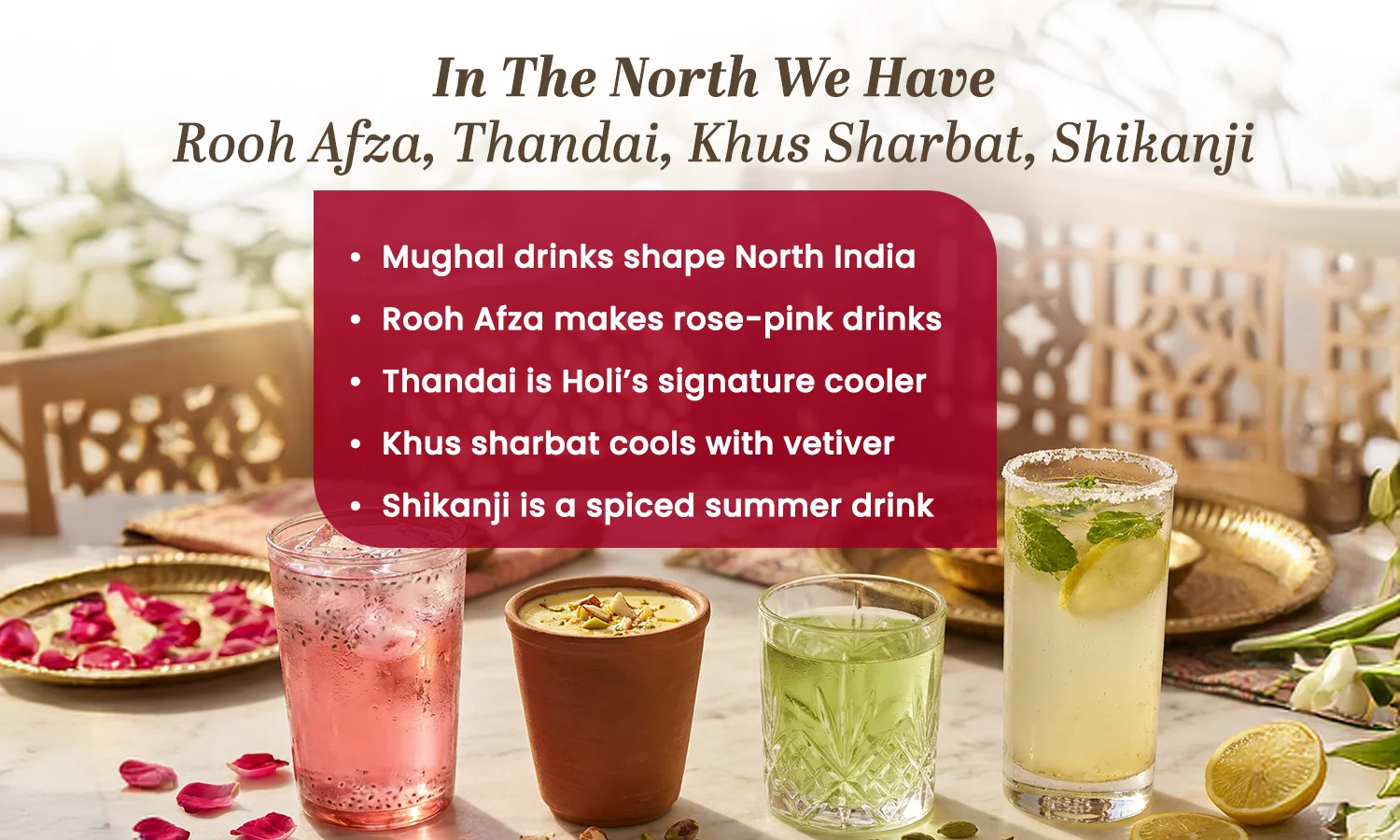
In The North We Have: Rooh Afza, Thandai, Khus Sharbat, Shikanji

The North carries the Mughal beverage inheritance. Rooh Afza, the iconic rose-and-herb syrup from Delhi, turns milk and water into a rose-pink ritual. Thandai, a cardamom-fennel-almond cooler, is the official drink of Holi. Khus sharbat, made from vetiver roots, is a deeply cooling green-coloured classic. Shikanji, the Punjabi lemonade with cumin and rock salt, is summer’s work-horse. When you list types of sharbat in India, the North alone contributes five world-class candidates.

Kashmir: Noon Chai Reversed, Sheer Chai Cooled

Kashmir’s summer drink culture is subtle; the famous pink noon chai is served cold in July, while yakhni-based buttermilk preparations surface in warmer months. It is less a sarbath tradition and more a savoury cooler tradition, a reminder of how regionally different Indian summer really is.

Central India: Sattu Sharbat, Belpatra Cooler

Bihar, Jharkhand, and eastern UP drink sattu sharbat, roasted gram flour, water, lime, and salt as a summer field drink. Sattu is the unglamorous hero of rural Indian hydration: protein-dense, electrolyte-rich, and built for 45-degree afternoons.

Why Traditional Indian Summer Drinks Are Winning in 2026

The 2026 Nielsen FMCG Pulse reported a 23% YoY volume rise in traditional Indian beverage syrups and a compound decline in sugary carbonated soft drinks. The reasons are layered: label literacy, wellness narrative, quick-commerce democratising availability, and a Gen Z shift toward cultural authenticity. The best sharbat conversation has moved from fringe to mainstream, and brands with authentic product heritage are the biggest winners.

How to Make Sharbat the Traditional Way

The core principle across almost every regional sarbath drink: concentrate + water + acid + salt. A concentrated syrup (nannari, rose, kokum, bel, khus) is diluted with chilled water, balanced with lime or tamarind, and corrected with rock salt. The ratio is personal. If you want a shortcut, how to make sharbat genuinely starts with owning a good concentrate, and SGR 777 Foods nannari and rose range covers the two most universally-loved versions of the tradition.

FAQs

What Are the Most Popular Types of Sharbat in India?Nannari sarbath, rose sharbat, khus sharbat, bel sharbat, aam panna, kokum, and thandai are the seven most widely consumed. Nannari and Rose remain the two pan-Indian leaders.
Which Sharbat Is Best for Heat Stroke?Nannari sarbath is the traditional prescription, followed by aam panna and sattu sharbat; all three are electrolyte-supportive and cooling.
Can I Mix Two Sharbats Together?Yes. Nannari-rose, rose-kokum, and bel-lime are all popular hybrids on modern bar menus.

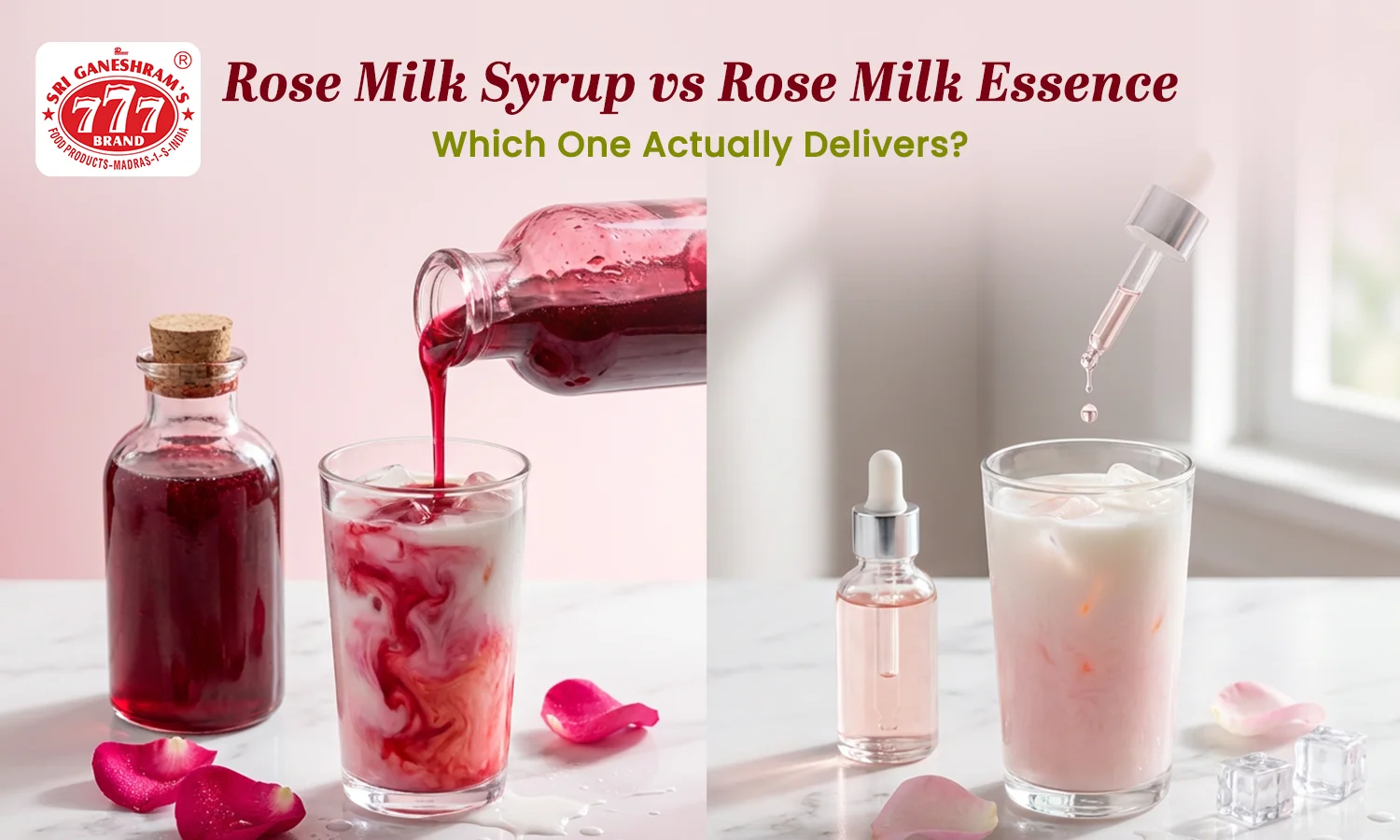
Rose Milk Syrup vs Rose Milk Essence: Which One Actually Delivers?

Walk the beverage aisle of any Indian supermarket, and you will find at least three products that look like the same thing. Rose syrup. Rose milk syrup. Rose milk essence. The bottles look similar, the colours look similar, and the prices look similar. The products, however, are not. Understanding what separates them is the difference between an authentic rose milk and a pink-coloured disappointment.

What is a Traditional Rose Syrup?

Traditional rose syrup is a thick, dense concentrate made by simmering real rose petals (or high-grade rose-petal extract) with sugar and a whisper of cardamom or saffron. It has a body, a deep rose-red colour that comes from the petals themselves, and a fragrance that opens when you pour it. SGR 777 Rose Syrup belongs in this category; it is the recipe that has built the brand’s reputation for decades. This is the syrup you want when you care about taste, aroma, and tradition.

What is a Rose Milk Syrup?

A rose milk syrup is a rose syrup formulated specifically to pair with dairy, typically slightly thinner, sometimes with an added stabiliser, so it blends cleanly into milk without curdling or separating. Good rose milk syrups, including SGR 777‘s, are essentially traditional rose syrups with pairing in mind. Cheaper versions lean heavily on added flavourings and colour. The milk rose syrup category as a whole can deliver excellent results if the brand is honest. Rose Milk Essence

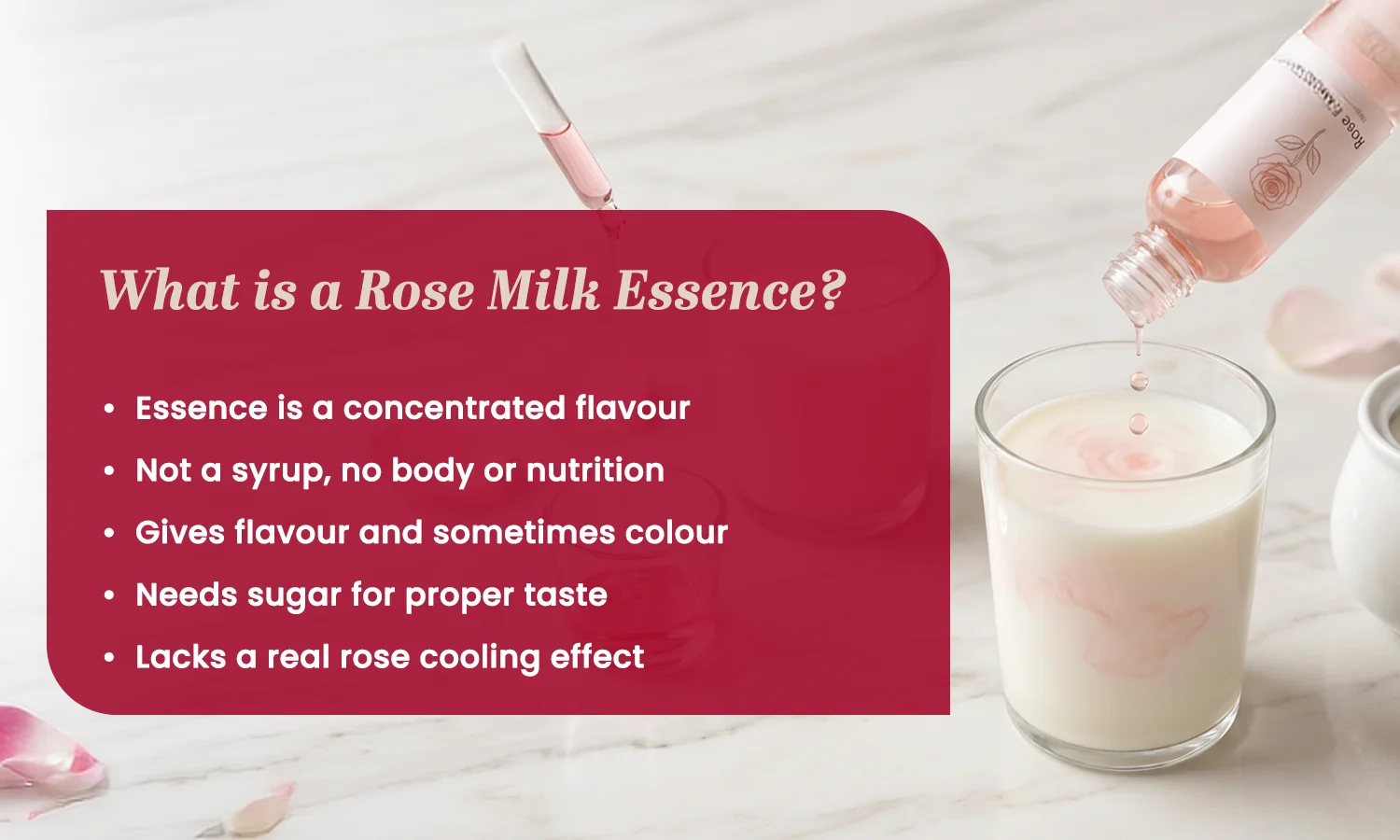
What is a Rose Milk Essence?

This is where confusion hurts shoppers. Rose milk essence is typically a concentrated flavour compound, sometimes nature-identical, sometimes synthetic, that is suspended in a thin liquid base. It is not a syrup. It contributes flavour and often colour, but not body, not nutrition, and not the cooling effect of real rose. Recipes calling for rose essence for rose milk will always need additional sugar and often a colouring agent because the essence alone cannot carry the drink.

Why the Difference Matters in Your Glass

Take the same two tablespoons, stir them into the same glass of cold milk, and you will get three very different outcomes. A traditional syrup delivers body, aroma, and lasting rose notes. A rose milk syrup blends smoothly and gives a balanced, dessert-like drink. An essence produces a pale-pink milk with a flat, sharp synthetic note, pleasant for a moment, forgettable by the second sip.

How to Read the Label

  • The ingredients list begins with ‘rose’ or ‘rose petal extract’, a good sign.
  • Thick pour, deep natural rose-red colour, it is likely authentic.
  • The ingredients list begins with ‘water, sugar, permitted synthetic food colour’, likely a cheaper formulation.
  • Very thin, runny consistency straight from the bottle, leaning toward essence, not syrup.
  • Price per 750 ml below ₹140 in organised retail is usually a red flag.

Price Context

The rose syrup price in India typically ranges from ₹160 to ₹320 for a 750 ml bottle. Authentic petal-based syrups sit at the top end. Essences sit at the bottom. A rose sharbat bottle at a suspiciously low price point is almost always an essence-led product with minimal real rose content.
Rose Milk Essence

When Each Product Makes Sense

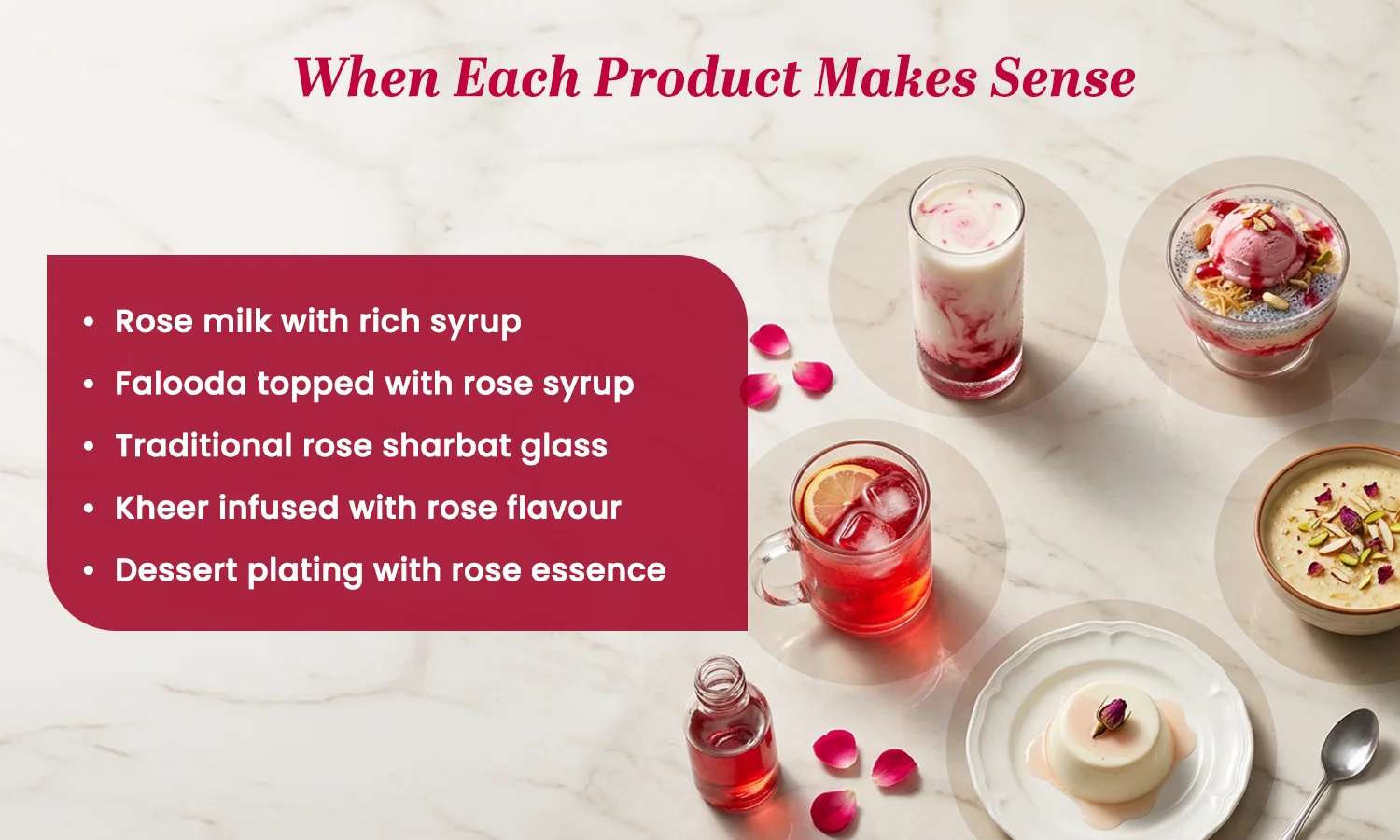
Use a traditional rose syrup or a proper rose milk syrup, like SGR 777’s, for any recipe where flavour is the hero: rose milk, rose sharbat, rose kheer, falooda, and desserts. Use a rose essence only for cases where you need a tiny, concentrated flavour hit in large-volume baking or for colour correction in plated desserts. They serve genuinely different purposes.

The SGR 777 Promise

Every bottle of SGR 777 Rose Syrup is built as a traditional, petal-based rose syrup, engineered to perform equally beautifully as rose syrup for rose milk, rose sharbat, rose kheer, falooda, or dessert drizzles. One honest bottle, infinite uses.

FAQs

Can I Use Rose Essence Instead of Rose Syrup?Technically, yes, but you will need to add sugar, water, and colour separately. For rose milk and rose sharbat specifically, a proper rose syrup delivers a substantially better result.
Does Rose Syrup Expire?Sealed and stored correctly, a traditional rose syrup stays at peak quality for 12–18 months. Once opened, refrigerate and finish within 30–45 days.
Which Rose Syrup Is Best for Falooda?A traditional, thick rose syrup works best for falooda because it sits beautifully at the base of the glass and flavours the layers. SGR 777 Rose Syrup is formulated to work for both rose milk and falooda without compromise.

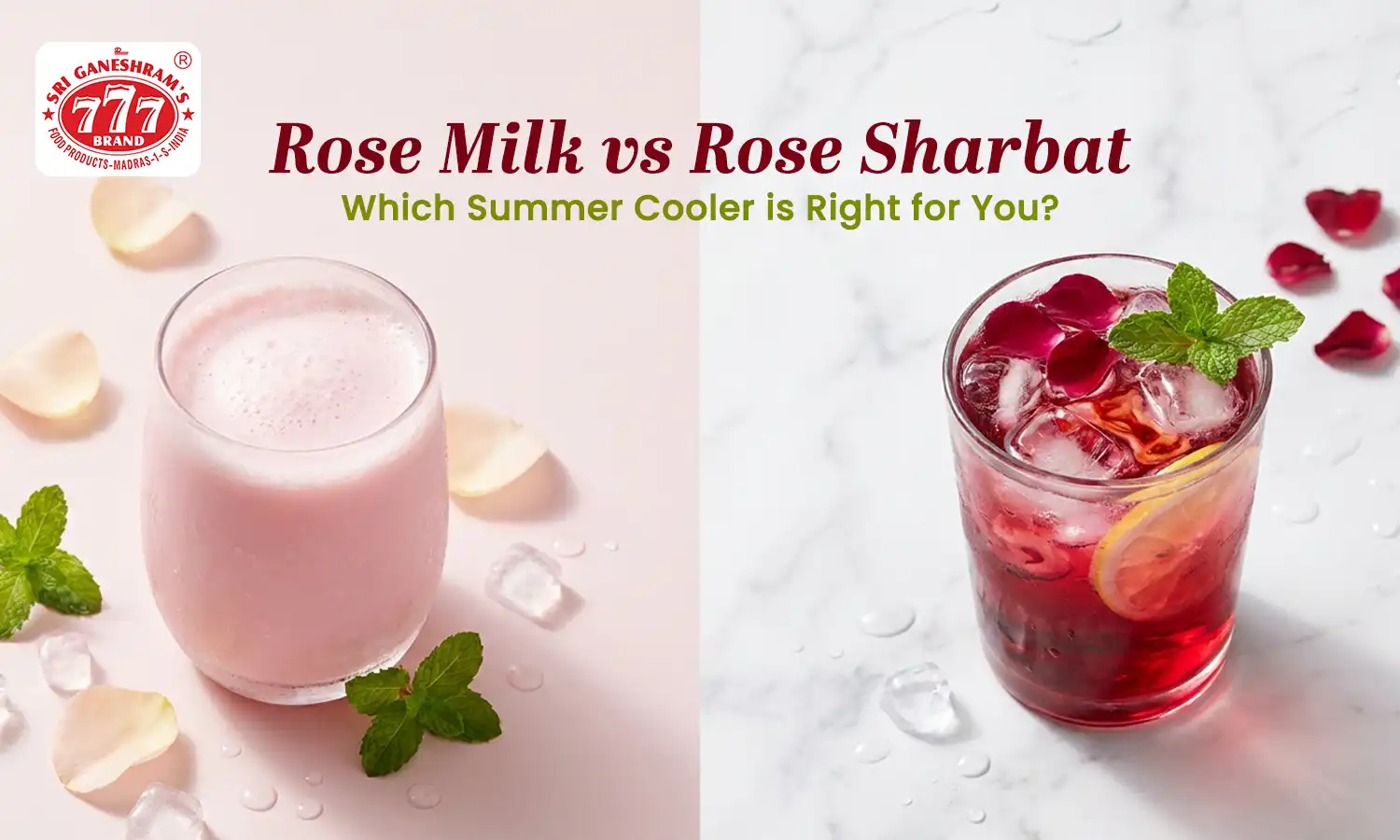
Rose Milk vs Rose Sharbat: Which Summer Cooler is Right for You?

Two glasses sit on every Indian summer table. Both are pink. Both are cold. Both are delicious. But one is creamy, cloud-soft and dessert-like while the other is clear, tangy and instantly thirst-quenching. The question every shopper asks before heading to the fridge in May is simple: rose milk or rose sharbat? The answer depends on what your body is actually asking for.

What is Rose Milk?

The question of what rose milk is has a one-sentence answer: chilled full-cream milk whisked with rose syrup, and optionally a pinch of cardamom or crushed ice. That’s the entire recipe. The rose milk ingredients list is short. It has milk, SGR 777 Rose Syrup, ice, and that minimalism is precisely what makes it great. How to prepare rose milk is closer to pouring than cooking.
The benefits of rose milk come from the combination. Milk delivers calcium, protein, and gut-soothing fats; rose adds cooling, mood-balancing, and mildly anti-inflammatory properties. A 250 ml glass lands at roughly 180–220 kcal, depending on sugar, which is lighter than a café milkshake, more nourishing than a soft drink. Rose milk benefits are most noticed as a late-afternoon energy lift, a post-dinner digestive aid, and a calming drink on hot, sleepless nights.
Rose Milk

What is Rose Sharbat?

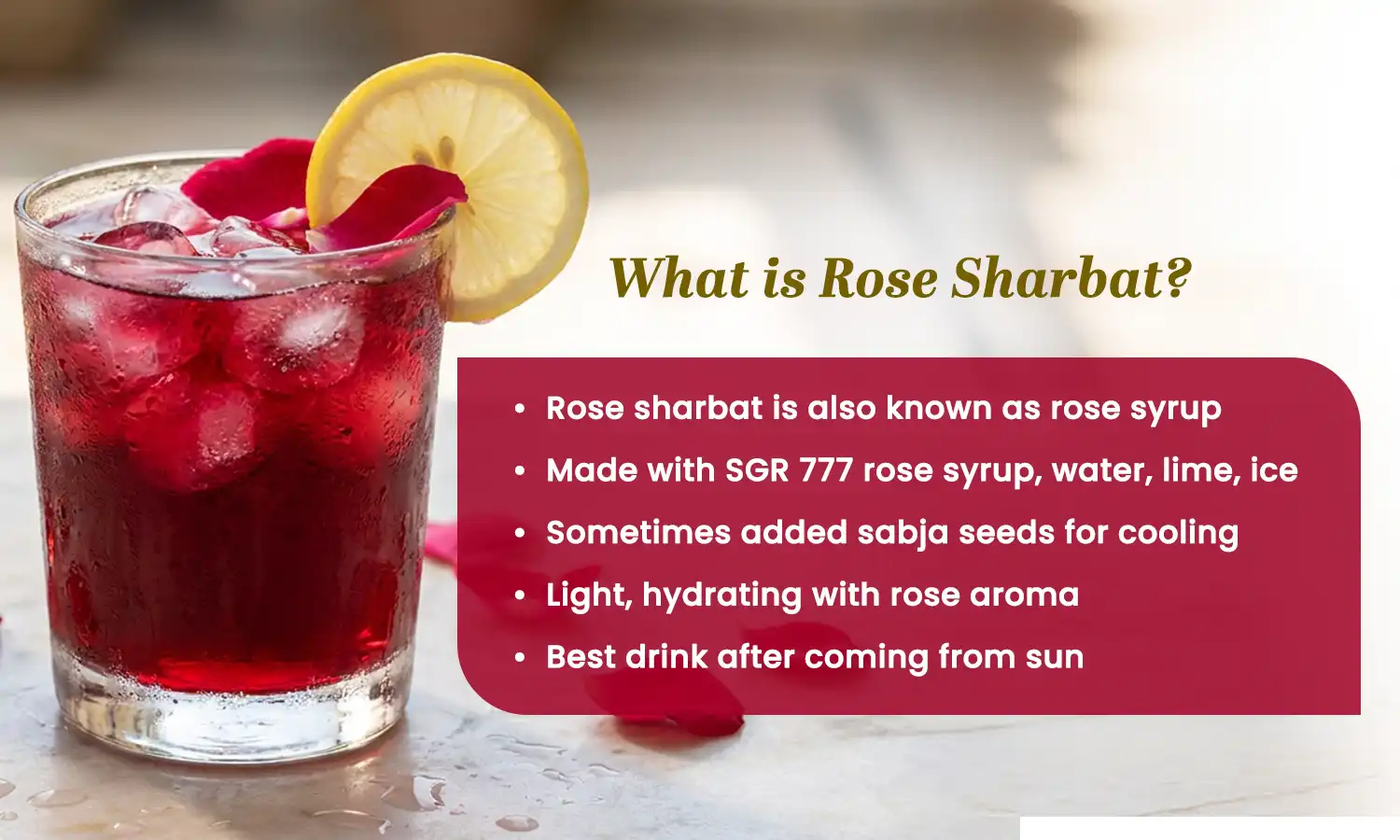
Rose sharbat is sometimes spelled sharbat rose or rose sharbat. The rose sharbat recipe uses 2 tbsp SGR 777 Rose Syrup, 200 ml chilled water, a squeeze of lime, ice, and occasionally a few sabja seeds. It is lighter, more hydrating, and delivers the rose aroma without the cream.If rose milk is a cooling dessert, rose sharbat is a cooling refresher. You would drink rose milk sitting down; you would drink rose sharbat after coming in from the sun.
Let’s have a side-by-side comparison:

Attribute Rose Milk Rose Sharbat
Base Chilled milk Chilled water + lime
Texture Creamy, dessert-like Clear, refreshing
Calories (250 ml) 180–220 kcal 90–120 kcal
Best For Energy lift, acidity relief, bedtime Post-sun thirst, for hydration
Hydration Moderate High
Fasting-friendly No (contains dairy) Yes

How to Choose Between Them?

Pick rose milk when you want indulgence with benefit, a creamy cooler after lunch, or a comforting glass before bed. Pick rose sharbat when you need immediate hydration, when you are fasting, or when you want a lighter calorie profile. Many households keep one bottle of SGR 777 Rose Syrup at home and make both from the same ingredient; the syrup is genuinely dual-purpose. Rose Milk

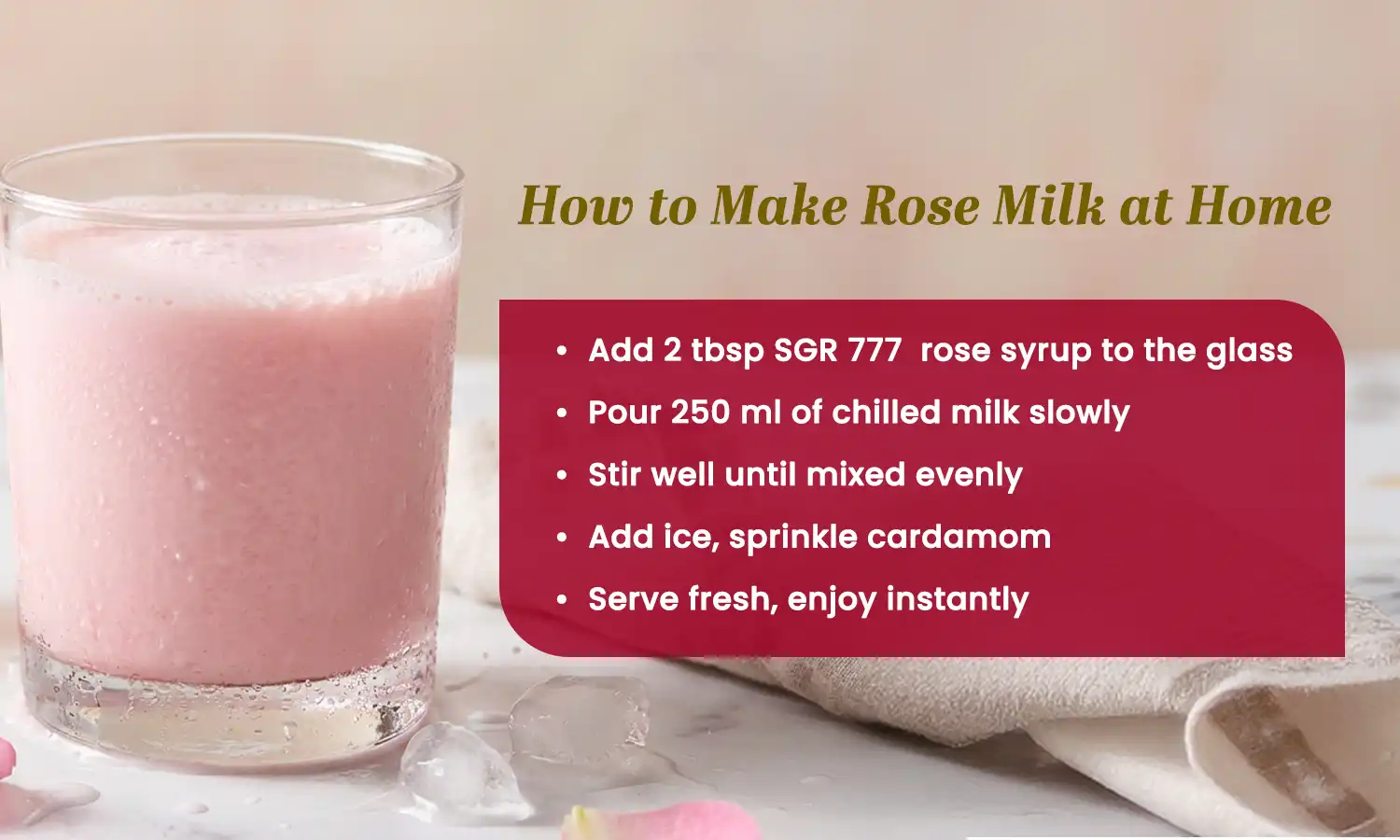
How to Make Rose Milk at Home

1. Pour 2 tbsp SGR 777 Rose Syrup into a tall glass.2. Add 250 ml chilled full-cream milk slowly.
3. Stir, top with ice and a dust of cardamom. Serve immediately.
That’s the entire rose milk recipe. How to make rose milk at home is less a recipe than a ratio; get the syrup right, and the drink follows.

A Note on Price

A rose sharbat bottle from SGR 777 Foods costs roughly the same as a rose milk syrup bottle because it is the same product, one versatile syrup that makes both drinks. The rose sharbat price in the Indian market generally sits between ₹160–₹320 for a 750 ml pack, depending on brand and formulation.

FAQs

Can I Make Rose Milk Without Sugar?Yes. SGR 777 Rose Syrup already contains a balanced sweetness, so most people don’t add extra sugar. If you want a lower-sugar glass, dilute the syrup slightly more.
Is Milk Sharbat the Same as Rose Milk?Close, but not identical. Milk sharbat is a general category, any milk-based sweetened drink. Rose milk is specifically milk + rose syrup.
Which Is Healthier, Rose Milk or Rose Sharbat?Neither is categorically healthier. Rose milk is more nutritious per glass (due to dairy); rose sharbat is lighter, more hydrating, and lower-calorie. Both deliver rose’s cooling benefits.

The Complete Health Benefits of Nannari Root: An Ayurvedic Deep Dive

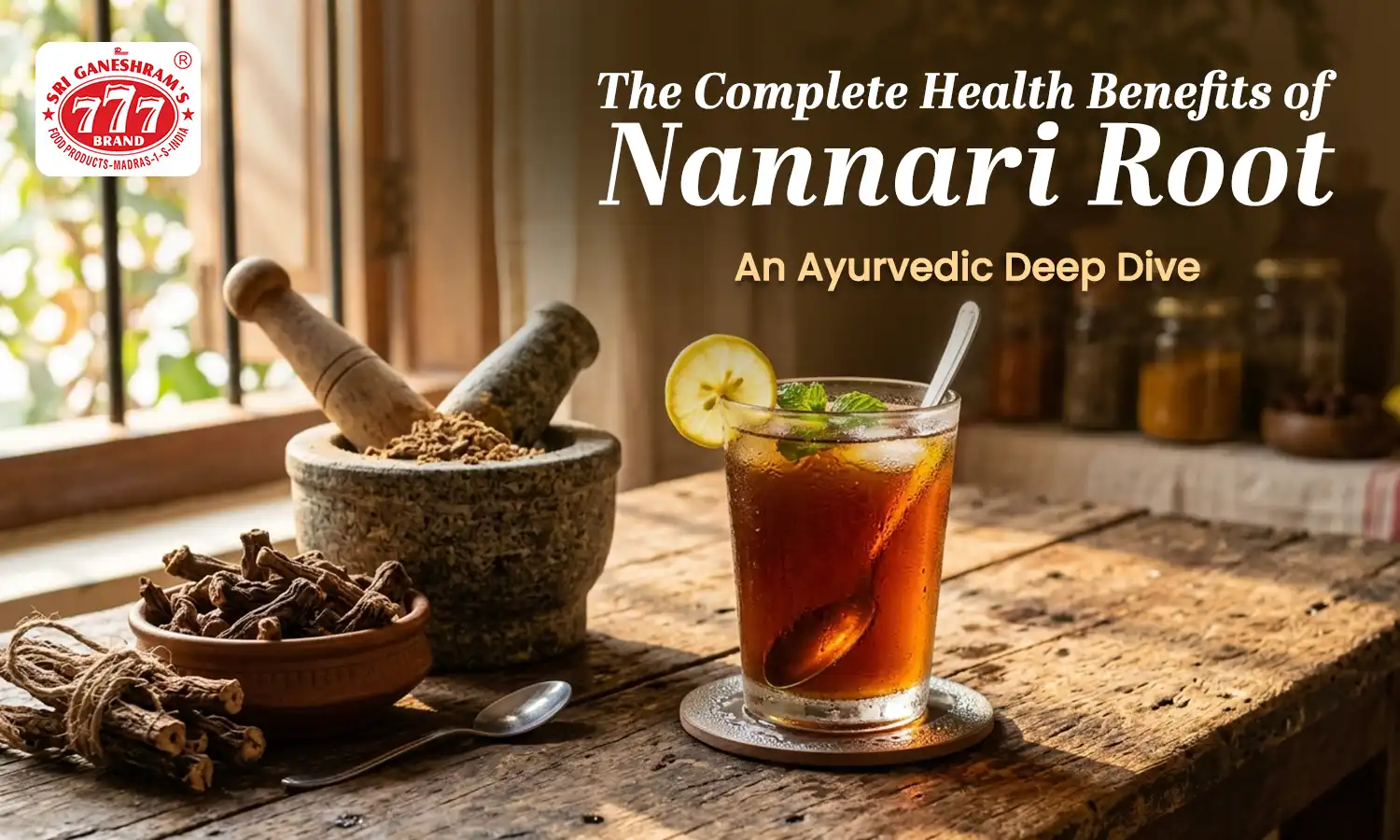
Most Indian households know the nannari root only by its finished form: a bottle of fragrant, mahogany-coloured syrup on the kitchen shelf. Few realise the root itself is one of the most documented herbs in Indian traditional medicine, with more than two thousand years of clinical use in Ayurveda, Siddha, and Unani. This is a ground-up look at what the root actually does, why it works, and how the nannari sharbat benefits you feel in a single glass comes from real chemistry, not folklore.

What’s the Root, Let’s Go Botanically:

Nannari is the South Indian name for Hemidesmus indicus, Indian Sarsaparilla. In Sanskrit, it is anantamool, ‘the eternal root’. In Malayalam, naruneendi. Nannari in Kannada is sogadeberu. It is a slender twining shrub with slim red roots and a distinctive vanilla-and-woodsmoke aroma. The part used is almost exclusively the root, either as a decoction, a powder, or an extract, which is what you know as nannari syrup now.

What’s The Ayurvedic Classification For This?

Classical Ayurvedic texts classify nannari root as sheeta virya (cooling potency), madhura rasa (sweet taste), and pitta-pacifying. In plain language: it cools, it nourishes, and it calms the body’s heat-driven disorders. Ayurveda further designates it a rakta shodhana dravya, a blood purifier, which is the reason it features in so many traditional skin-health formulations. Nannari Root

What Are The Ten Documented Benefits Of Nannari?

Drawing on Ayurvedic practice and contemporary phytochemical research, including a 2026
A review in the Journal of Ethnopharmacology that catalogued over forty bioactive compounds in the root, the nannari syrup benefits span a remarkable range:
1: Natural body coolant regulates internal temperature and prevents heat stroke.
2: Blood purifier, supports liver detoxification, and clearer skin.
3. Digestive aid, relieves acidity, improves appetite, and eases constipation.4. Urinary comfort, mild diuretic, calms urinary burning sensations.
5. Anti-inflammatory support, saponins, and flavonoids reduce systemic inflammation.
6. Antioxidant profile, rich in phenolic glycosides that neutralise free radicals.
7. Skin clarification, traditionally applied for heat boils, prickly heat, and acne.8. Hydration support encourages fluid intake without the harms of aerated drinks.
9. Mild immunomodulation, seasonal resilience during summer transitions.
10. Post-fever recovery, Siddha tradition uses it in convalescence tonics.

How the Root Works Inside the Body?

The active compounds responsible for most of the benefits above include saponins (mildly diuretic, anti-inflammatory), flavonoids (antioxidant, vascular-protective), and a distinctive volatile called 2-hydroxy-4-methoxybenzaldehyde, the molecule responsible for the root’s signature vanilla note. Together, they explain why a single glass of a nannari drink can feel so restorative within thirty minutes on a hot afternoon.

Who Should Be Cautious of Having Nannari?

Nannari is a gentle herb with a wide safety margin. That said, moderate caution is recommended for people on diabetes medication (because of mild glucose-modulating effects), pregnant women (consult an Ayurvedic physician), and anyone on prescription diuretics. For most healthy adults, a daily glass of nannari sarbath through summer is both safe and beneficial.
Nannari Root

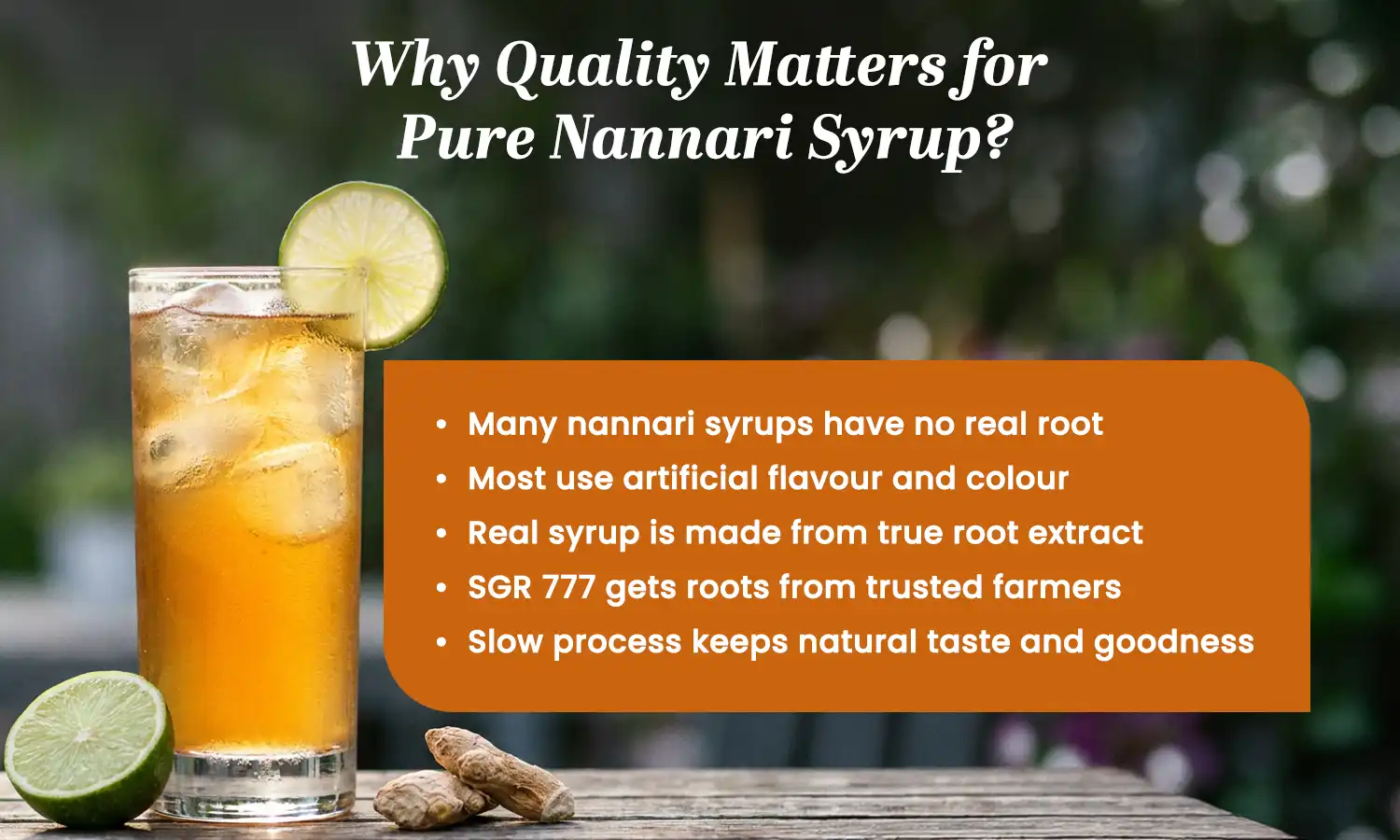
Why Quality Matters for Pure Nannari Syrup?

Here is a truth the FMCG market doesn’t advertise enough: a large share of products labelled as nannari syrup contain minimal actual root. Most use synthetic sarsaparilla essence and caramel colour.
When you ask what nannari syrup is, the honest answer should always be: a concentrated extract of the real nannari root. SGR 777 Foods builds its Nannari Syrup that way, sourcing the root from verified farmer networks in Tamil Nadu and Andhra Pradesh and slowly extracting it to preserve the full aroma and bioactive profile.

How to Consume Nannari Regularly?

Can you consume Nannari regularly? Yes, if you have to go through this intense summer heat. The simplest and most enjoyable route is a daily glass of traditional nannari sarbath through summer: 2–3 tbsp SGR 777 Nannari Syrup, water, lime, optional sabja. For more targeted Ayurvedic use, powder or decoction, you need to consult a qualified practitioner. The daily glass is what most Indian families have relied on for generations.

FAQs

Is nannari root the same as regular sarsaparilla?No. Hemidesmus indicus (Indian Sarsaparilla / nannari) and Smilax species (regular Sarsaparilla) look similar and taste similar, but belong to different genera with distinct chemistry.
Can nannari root be consumed daily?
Yes, in moderate beverage form, such as nannari sarbath, daily summer consumption is safe for most healthy adults.
How long before I feel the benefits?Cooling effects are usually felt within 20–30 minutes. Blood-purifying and digestive benefits become noticeable over 2–4 weeks of regular summer consumption.

Nannari Sarbath Recipe: 7 Authentic South Indian Variations You Must Try This Summer

Introduction

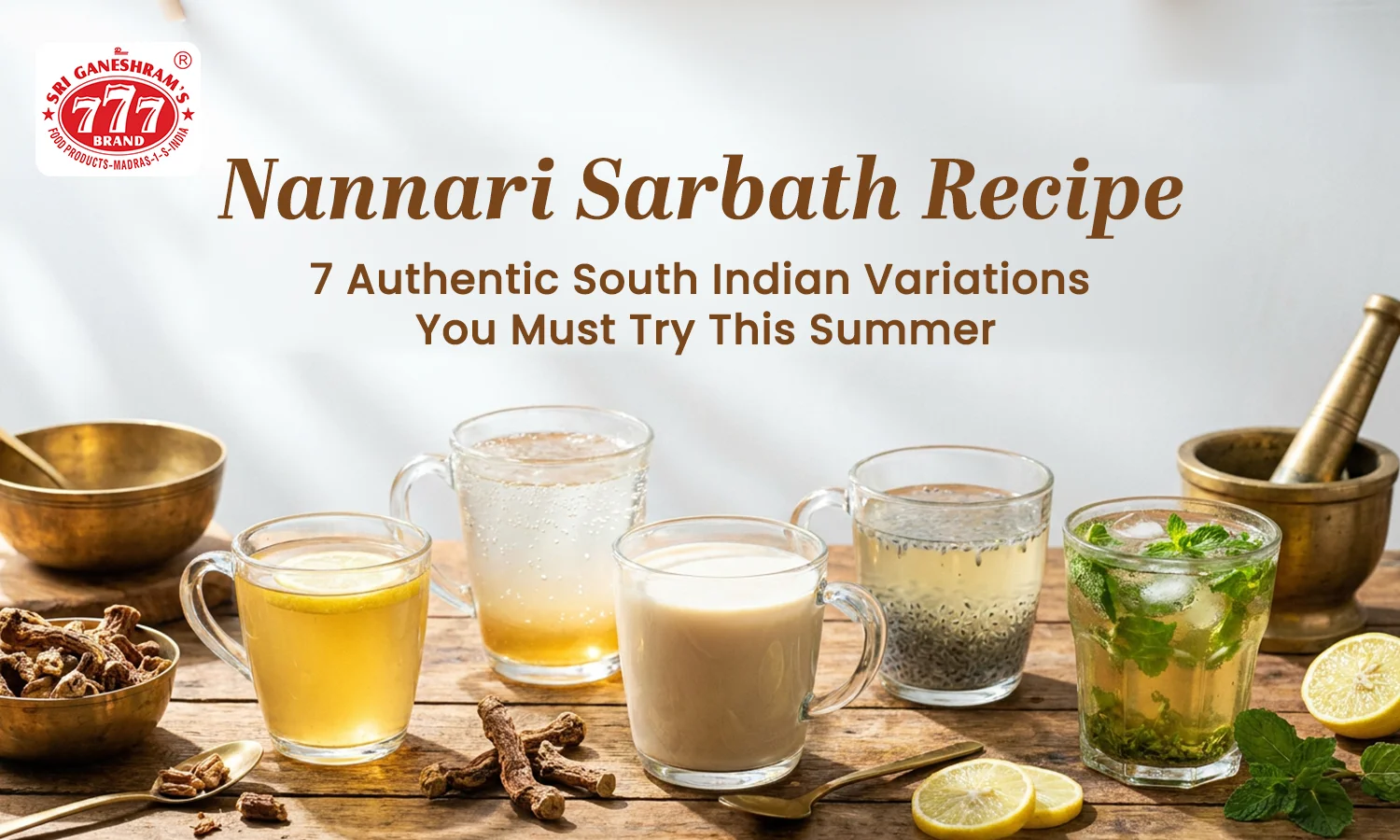
Ask any South Indian what a nannari sarbath recipe looks like, and you will get seven different answers. It’s because every household, every temple town, and every tea stall has its own version of this beloved summer cooler. The base is identical: nannari syrup, water, lime, but the way each region tweaks it is what turns a simple nannari drink into a signature of place.
Here are seven authentic variations worth bottling into your summer repertoire, each built around the same trusted starting point: a bottle of SGR 777 Nannari Syrup.

The Core Nannari Sarbath Ingredients

Before jumping into variations, it helps to know the non-negotiable nannari sarbath ingredients: good-quality nannari syrup (the single biggest determinant of taste), cold water, fresh lime, a sweetener, and something aromatic or textural like sabja seeds, cardamom, or rock salt. Everything else is a regional personality.
Nannari Sarbath Recipe

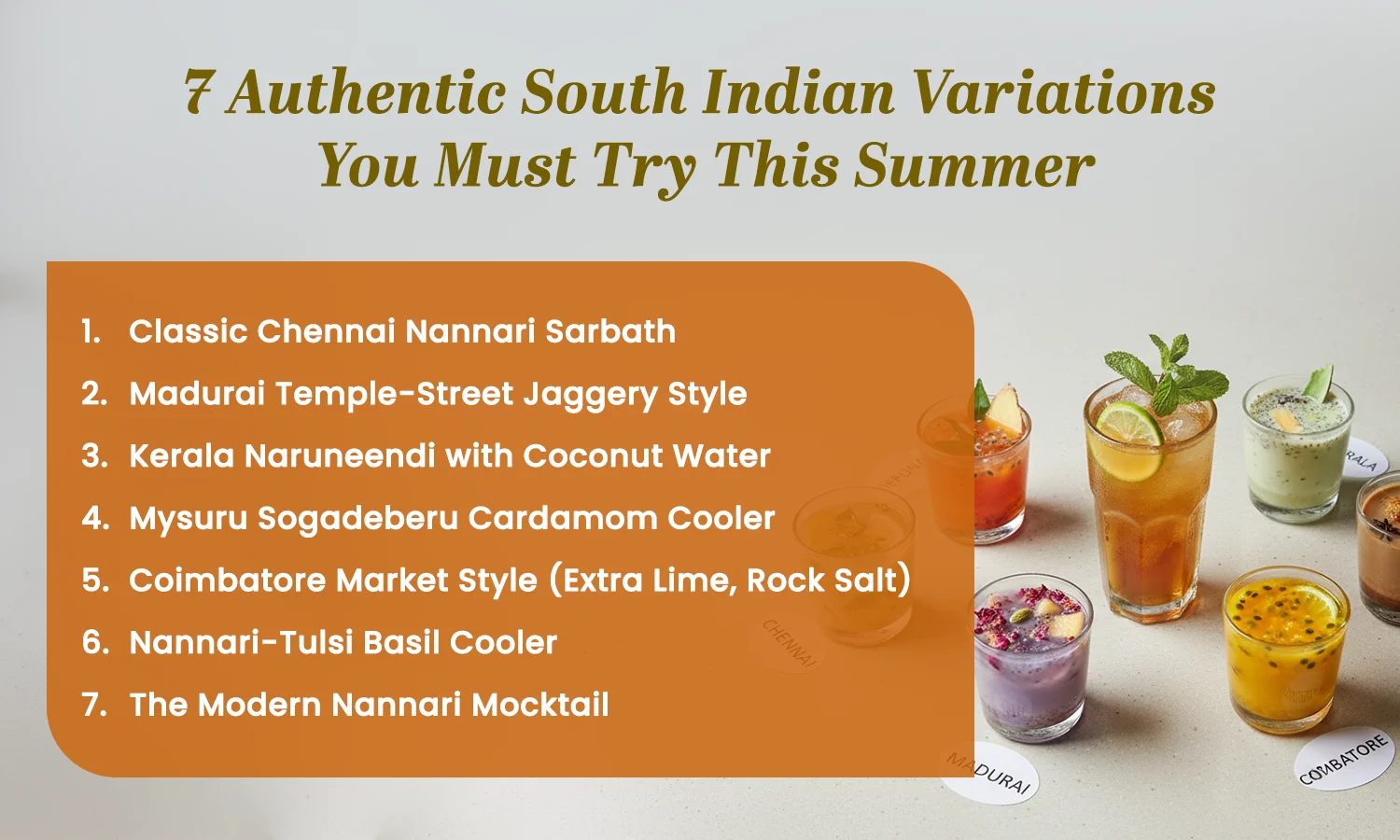
1. Classic Chennai Nannari Sarbath

The city benchmark. 3 tbsp SGR 777 Nannari Syrup, 250 ml chilled water, juice of half a lime, 1 tsp soaked sabja seeds, crushed ice. Stir, serve immediately. This is the gold-standard answer to how to make nannari sarbath. It is quick, balanced, and the reason why Chennai’s filter-coffee shops have been pouring it for decades.

2. Madurai Temple-Street Jaggery Style

In Madurai, the nannari sarbath juice served near the Meenakshi temple swaps refined sugar for jaggery, giving it a darker caramel note and a mineral depth. Use 2 tbsp of SGR 777 Nannari Syrup with 1 tbsp jaggery syrup, water, lime, and ice. It will taste older, but in the best possible way.

3. Kerala Naruneendi with Coconut Water

Kerala calls it naruneendi and pours it over chilled tender coconut water instead of regular water. The result is an electrolyte-loaded cooler that tops every post-workout recovery drink on the market. 2 tbsp nannari syrup, 200 ml coconut water, a squeeze of lime, no extra sugar needed.

4. Mysuru Sogadeberu Cardamom Cooler

In Karnataka, where nannari in Kannada is called sogadeberu, cardamom is king. Add a pinch of freshly crushed green cardamom to your classic sarbath mix, and the drink turns floral, almost perfumed. A single pod changes the entire personality of the glass and gives you the refreshment you deserve.

5. Coimbatore Market Style (Extra Lime, Rock Salt)

The Gandhipuram market version is aggressively tangy. Use double the lime, add a quarter teaspoon of rock salt, and skip the sabja. This is where the nannari sarbath with lemon benefits come alive. You get Vitamin C for immunity, electrolytes for sweat loss, and the cooling nannari base doing the heavy lifting.

6. Nannari-Tulsi Basil Cooler

A modern-wellness twist growing fast on Instagram since the summer of 2026. Muddle 4 tulsi leaves at the bottom of the glass before pouring in nannari syrup, water, a dash of honey, and lime. Let the basil infuse for 60 seconds. The result is a botanical cooler that drinks like a spa.

7. The Modern Nannari Mocktail

For parties, weddings, and summer brunches. 2 tbsp SGR 777 Nannari Syrup, 100 ml sparkling water, 50 ml fresh lime juice, mint leaves, ice in a copper tumbler. This is the sarbath juice a bartender would serve with traditional bones and a contemporary finish.

Why the Syrup Is Everything:

You can change the water, the lime, the salt, and the sugar. But the nannari syrup itself is non-substitutable. If you change this syrup with any of the thin, synthetic essence, it will betray every recipe above. A traditionally-brewed SGR 777 Nannari Syrup that is made from real Hemidesmus indicus root is the reason all seven variations actually taste like nannari. For the full story on the root, the science, and the heritage, see our website SGR777foods.

FAQs

Can I Prepare Nannari Sarbath in Bulk for a Party?Yes. Mix the syrup, water, and sugar ratios first, refrigerate in a jar, and add lime and ice only at serving time. Lime added too early can turn bitter.
How to Make Nannari Syrup at Home?Traditional nannari syrup requires boiling dried nannari root with sugar in a 1:2 ratio for several hours. It is labour-intensive, which is why most households start with a ready SGR 777 bottle for consistent flavour.
Is Nannari Sarbath Safe Daily?Yes, in moderation. Its cooling and digestive properties make it a traditionally recommended daily summer drink. Watch the sugar content if you are diabetic.

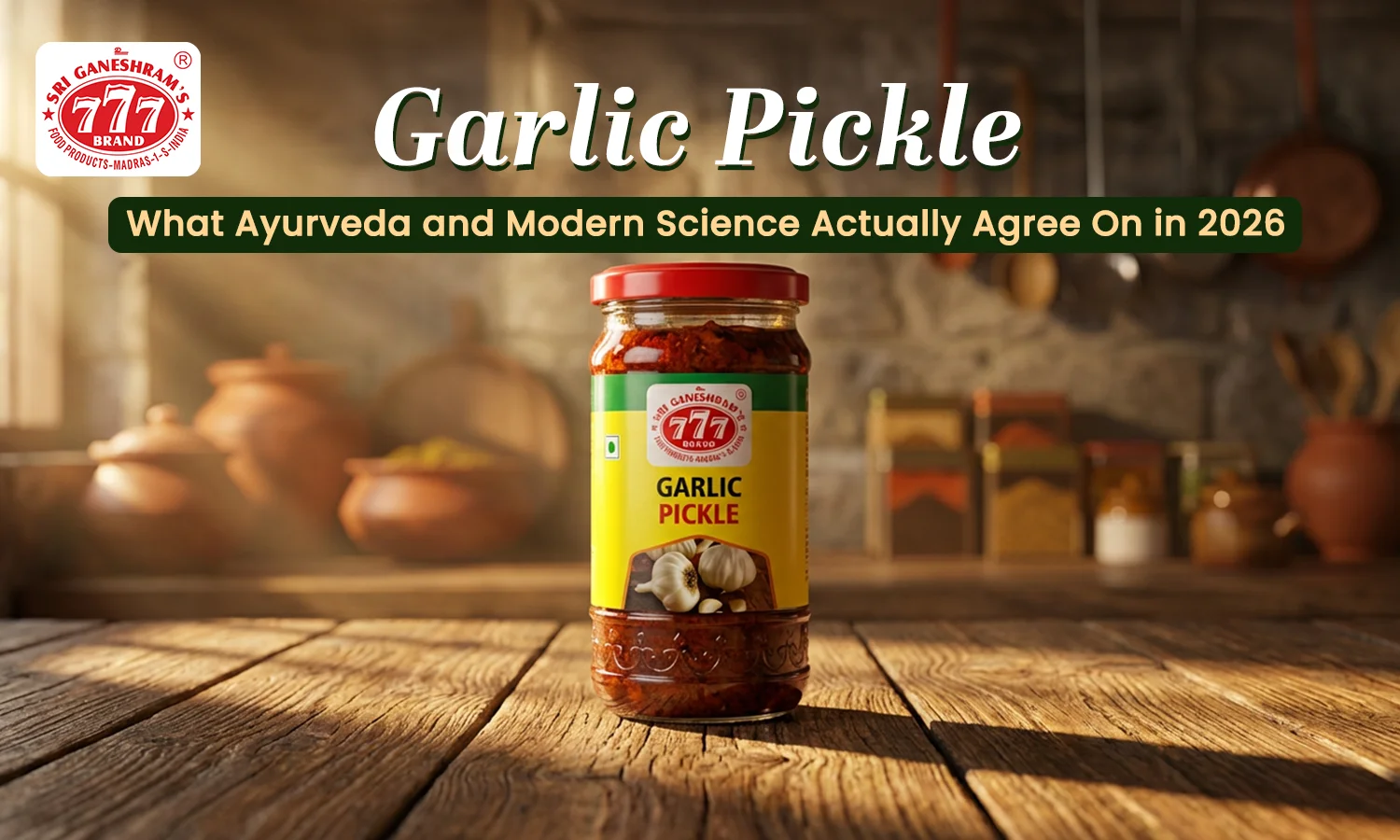
Garlic Pickle: What Ayurveda and Modern Science Actually Agree On in 2026

Introduction :

Garlic pickle is the rare Indian condiment where Ayurveda and modern nutrition science agree almost word-for-word. Ancient Sushruta texts classify raw and fermented garlic as rasayana, a rejuvenating category. A 2023 peer-reviewed meta-analysis published in the Journal of Nutrition concluded that aged garlic extract measurably reduces LDL cholesterol and improves endothelial function. The two systems arrived at the same conclusion 2,500 years apart.
This is why a well-made garlic pickle has stopped being a supporting player on Indian plates and started appearing as a centrepiece. In South Indian homes, a teaspoon of SGR 777 Garlic Pickle 300g with curd rice is now prescribed as often as turmeric milk.
Garlic Pickle

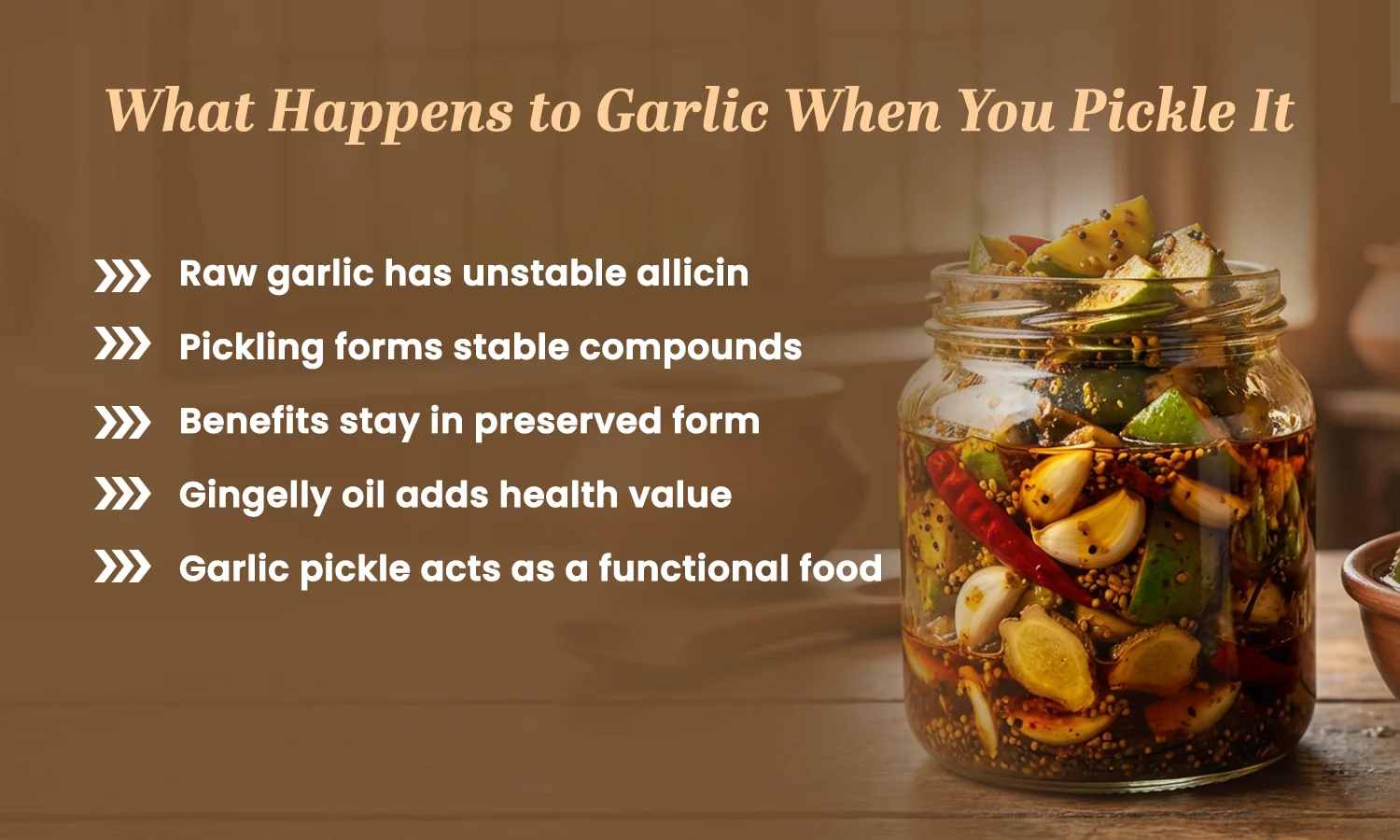
What Happens to Garlic When You Pickle It

Raw garlic contains allicin, a sulphur compound responsible for its sharpness. Allicin itself is unstable and degrades within hours of crushing. In a pickled jar, though, allicin converts into more stable organosulphur compounds like S-allyl cysteine. These are the compounds modern studies actually measure. In other words, pickling does not destroy garlic’s benefits; it converts them into more shelf-stable versions.
The oil base matters too. Gingelly oil contains sesamin and sesamolin, both shown to support cardiovascular and anti-inflammatory pathways. Combined with pickled garlic’s organosulphur compounds, a traditional South Indian garlic pickle becomes genuinely functional food, not just flavour.

Ayurvedic View: Garlic as a Seasonal Therapy

In classical Ayurveda, garlic is warming, pungent, and ideal for the late-monsoon and winter months when kapha tends to accumulate. Garlic pickle, specifically, is recommended because the oil and salt neutralise garlic’s sharpness enough for daily consumption without digestive discomfort.
The traditional dosage was modest, a small spoonful with one meal per day. That guideline still holds. A pickle consumed daily in moderation delivers the benefit profile; over-consumption simply adds sodium without improving outcome.

Modern Research on Pickled Garlic

The following was the research that was conducted recently, and is worth knowing:

  • A 2024 Indian Council of Medical Research review noted that traditional fermented garlic preparations retain 60–75% of their original allicin-derivative activity over 12 months of storage.
  • The American Journal of Clinical Nutrition has linked regular garlic consumption (approximately 3–5g/day equivalent) with modest reductions in systolic blood pressure.
  • Food Chemistry (2023) reported that gingelly-oil-based garlic pickles showed higher antioxidant retention than mustard-oil versions at equivalent storage periods.

None of this is a replacement for medical advice. A pickle is a condiment, not a treatment. But the evidence for regular, modest consumption as part of a balanced diet is now strong enough that most nutritionists no longer dismiss it as folk wisdom.

What Separates a Good Garlic Pickle from an Average One

The best garlic pickle passes four practical tests:
1. Whole peeled pods, not minced, not paste. The bite is half the pleasure.
2. Even with oil submersion, every pod should be visible through the oil layer.
3. Balanced heat enough chilli to cut garlic’s pungency, not enough to dominate.
4. Clean aftertaste, a good garlic pickle does not leave a metallic or rancid note.
SGR 777’s garlic pickle meets all four. It is hand-peeled, oil-set in gingelly, and batch-rested for 10 days before dispatch. The garlic pickle price sits at ₹110 for 300g. For reference, the garlic pickle 1kg price for bulk B2B buyers is approximately 20% lower per 100g, making it efficient for caterers and cloud kitchens.
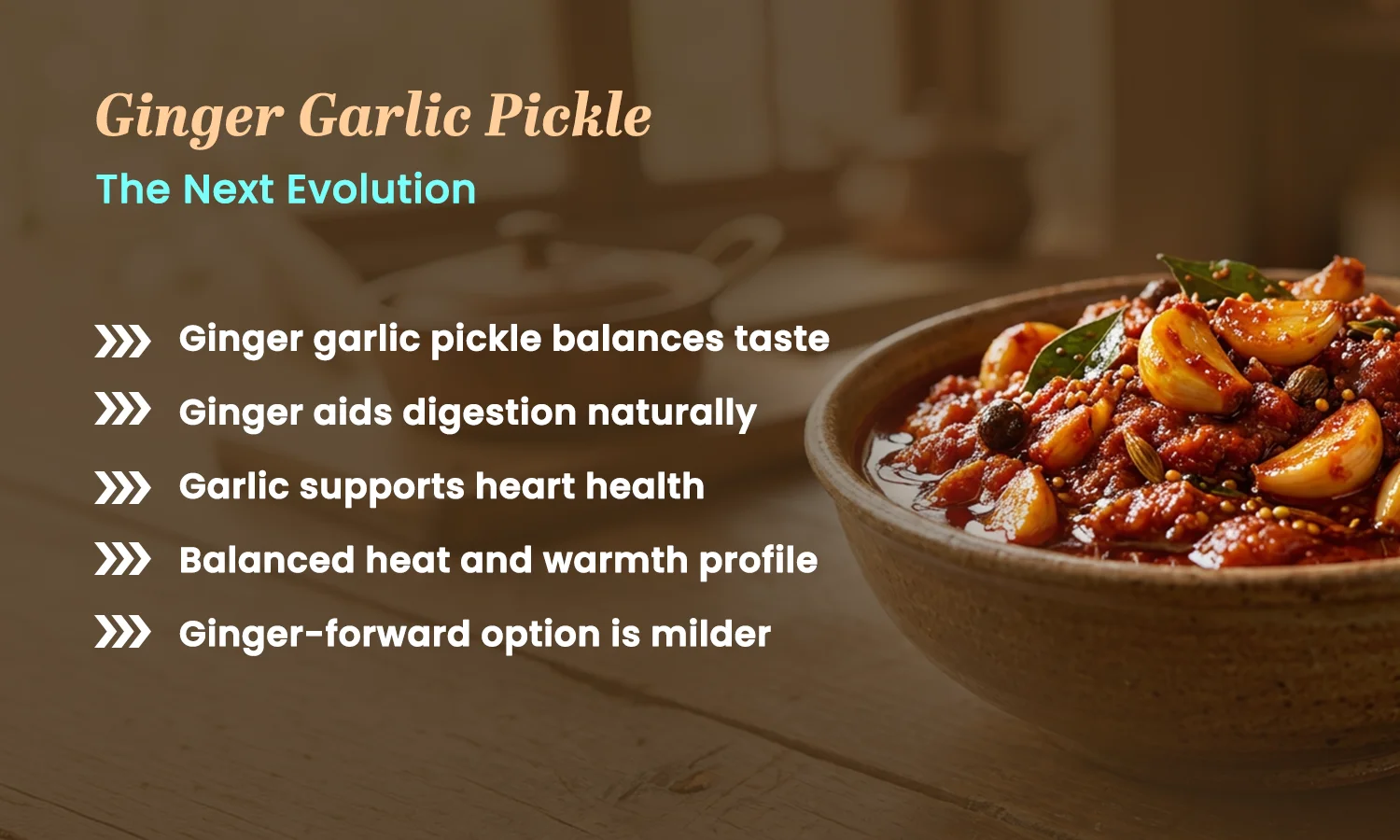
Ginger Garlic Pickle: The Next Evolution

Ginger Garlic Pickle: The Next Evolution

A common upgrade in South Indian kitchens is the ginger garlic pickle, where ginger’s digestive support complements garlic’s cardiovascular profile. The combination also balances heat and warmth on the palate. For readers who find pure garlic pickle too dominant, a ginger-forward option like the Ginger Pickle 300g is an easier entry point.

Buying Garlic Pickle Online Without Being Disappointed

Buying Garlic Pickles from resellers that sell damaged products can be disappointing. So when you order garlic pickle online in 2026, you can note these three signals that separate genuine brands from relabellers:

  • The ingredients list starts with garlic and gingelly oil, not with water, vinegar, or refined sunflower oil.
  • Packing date is printed (not only “best before”).
  • The jar has a visible oil layer upon delivery. A dry-looking pickle has either been stored poorly or formulated with insufficient oil.

Explore the complete SGR 777 pickle range, traditional and authentic, made in Chennai since 1954.

FAQs

How Much Garlic Pickle Can I Safely Eat per Day?One teaspoon (~5g) with a meal is the traditional dose. Regular, modest consumption is better than occasional heavy use. Anyone with prescribed blood-thinning medication should consult their doctor, since garlic can mildly enhance anticoagulant effects.
Does Pickling Destroy the Health Benefits of Garlic?No. Pickling converts unstable allicin into more stable organosulphur compounds, most of which retain the core benefits linked to raw garlic. Oil-based pickling preserves these better than water or vinegar bases.
Which Is Better for Garlic Pickles, Mustard Oil, or Gingelly Oil?Both work. Mustard oil is traditional in North Indian garlic pickles; gingelly is traditional in South Indian. Gingelly oil has a longer shelf life at Indian room temperatures and carries a milder aroma that suits daily use.
Are Garlic Pickles Available in 1KG Bulk Packs?Yes. SGR 777 offers bulk and institutional packs for caterers, hotels, and cloud kitchens at lower per-100g rates. Contact the brand’s trade desk for a price list.

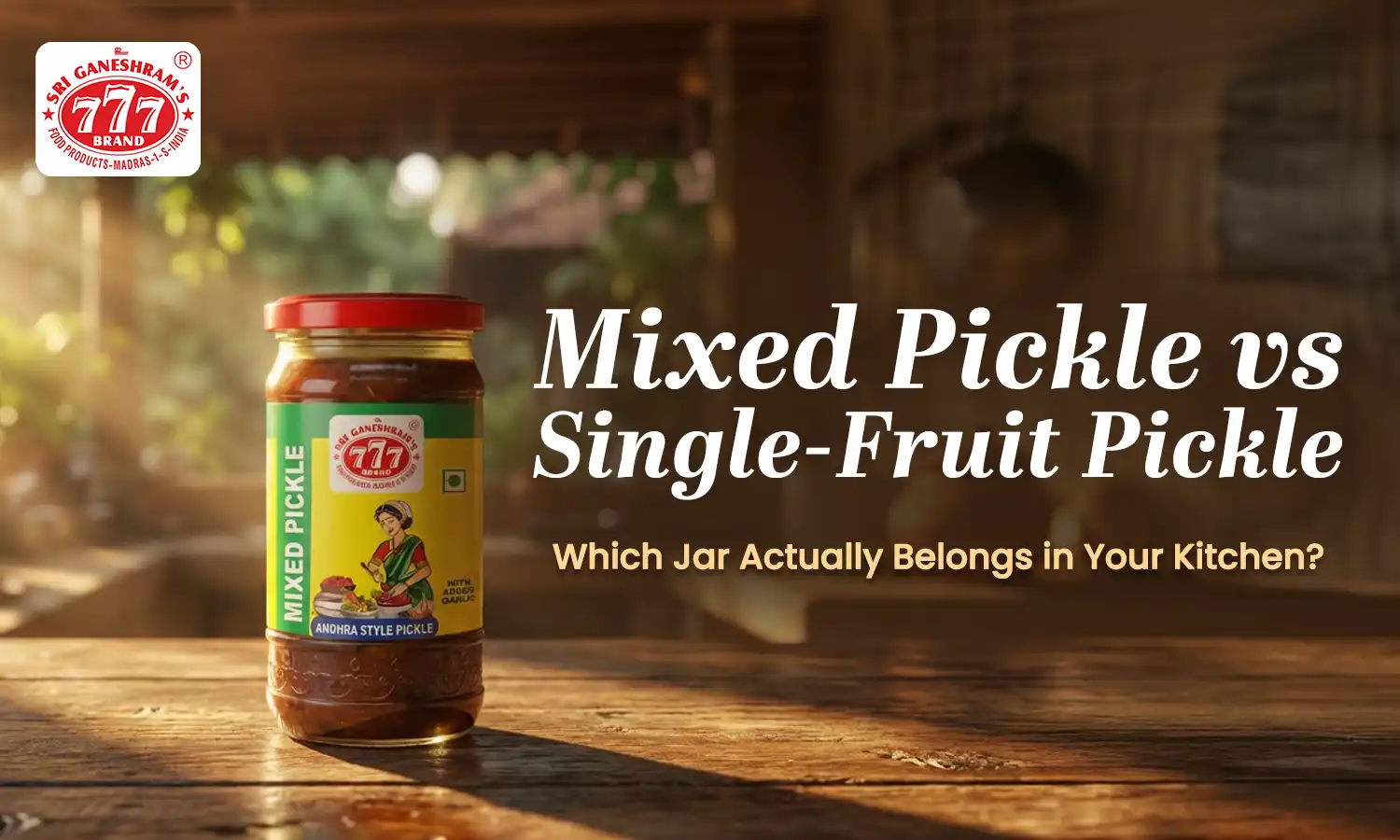
Mixed Pickle vs Single-Fruit Pickle: Which Jar Actually Belongs in Your Kitchen?

The most-asked question on Indian pickle shelves is not about heat or price. It is about variety. Should a household keep a mixed pickle jar that covers everything, or multiple single-ingredient jars, mango, lime, chilli, garlic, amla, that each do one thing well?
Both strategies are valid. Each solves a different problem. Understanding the difference saves money, fridge space, and plate fatigue. Mixed Pickle

What a Mixed Pickle Actually Is

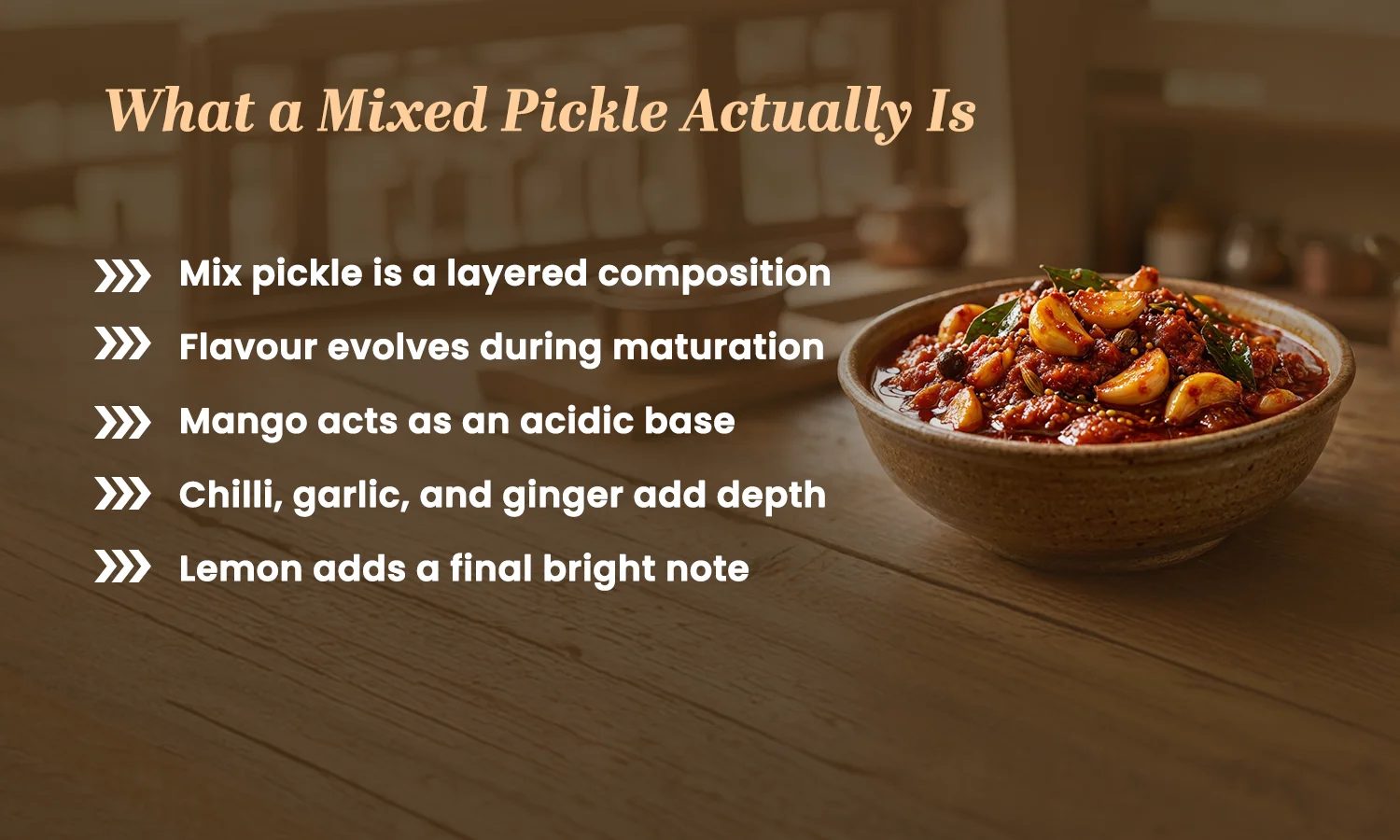
A true mix pickle is not a compromise; it is a composition. Traditional South Indian and North Indian mixed pickles layer 4–7 ingredients that release flavour at different maturation points. Early weeks taste mango-forward; later weeks shift to chilli and ginger. A well-constructed mixed vegetable pickle is, in that sense, a seasonal instrument, not a static product.
The most common mixed pickle ingredients in South Indian formulations are:

  • Raw mango: the acidic anchor
  • Green chilli and red chilli; heat
  • Garlic and ginger; aroma and digestive warmth
  • Carrot; textural crunch (carrot pickle also exists as a stand-alone variety)
  • Tamarind: a secondary sour note in some recipes, closely related to the standalone tamarind pickle category
  • Lemon or lime; finishing brightness

The SGR 777 Mixed Pickle 300g follows this classical layering, six ingredients, gingelly oil base, priced at ₹110. The mixed pickle price typically runs 5–10% higher than a single-fruit pickle because of the ingredient complexity.

When a Single-Ingredient Pickle Wins

A single-ingredient pickle lets one flavour dominate, and some ingredients deserve that solo spotlight. Consider:

  • Tomato pickle, impossible to reproduce inside a mixed jar because the water content destabilises other ingredients. The standalone tomato pickle preserves the smoky-tangy profile that gets lost in a multi-ingredient blend.
  • Onion pickle, onion’s sweetness collapses against the raw mango’s acidity. It needs its own jar.
  • Bitter gourd pickle, bitter gourd’s flavour is assertive and divisive; hiding it in a mix wastes it.
  • Coriander pickle and other herb-based pickles, these are finishing condiments, not staples

This is why SGR 777’s pickle range includes both: the Tomato Pickle 300g and the Hot Onion Pickle 300g sit alongside the mixed pickle, because each solves a flavour problem the other cannot. Mixed Pickle

Types of Pickles in India: A Quick Classification

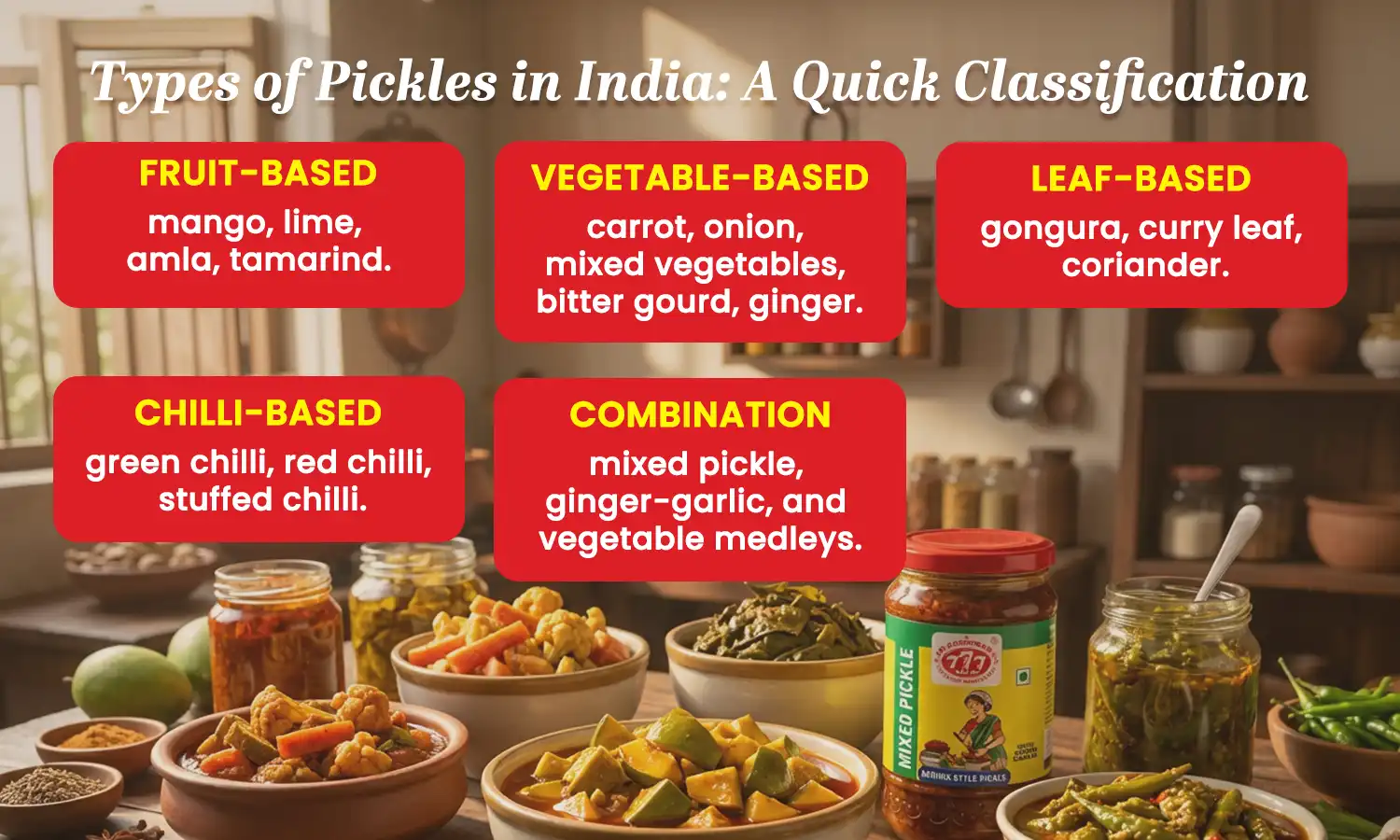
For readers searching for types of pickles in India or pickle types, the Indian pickle universe breaks into five families:
1. Fruit-based; mango, lime, amla, tamarind. The largest category.2. Vegetable-based; carrot, onion, mixed vegetables, bitter gourd, ginger.3. Leaf-based; gongura, curry leaf, coriander.4. Chilli-based; green chilli, red chilli, stuffed chilli.5. Combination; mixed pickle, ginger-garlic, and vegetable medleys.The veg pickles category, covering mix veg pickle, mixed veg pickle, and mix vegetable pickle, is one of the fastest-growing sub-segments in 2026, growing at 4.59% CAGR per Mordor Intelligence, faster than fruit pickles despite a smaller base.

Decide Which to Buy First:

Before you decide between our Mixed pickle and single fruit pickle, ask these three questions:1. How often do you use pickle? Daily users benefit from multiple single-ingredient jars that do not fatigue the palate. Occasional users should start with a mixed pickle.
2. How many people are in the household? A 2-person home rarely finishes five jars before they degrade. A mixed pickle is more efficient.
3. What do you eat? Rice-heavy diets demand variety; multiple jars win. Roti-heavy diets work well with a single mixed pickle and a garlic pickle.
A practical starting kit for an Indian household in 2026: one mixed pickle, one avakaya or cut-mango pickle, and one garlic or ginger pickle. That three-jar set covers 90% of daily meal pairings.

What About Pickle Mix vs Mixed Pickle? Are There Any Differences?

This is a good question, but it is often confused. Pickle mix typically refers to a dry spice blend used to make pickles at home, mustard, fenugreek, chilli, and turmeric in pre-measured ratios. Mixed pickles are the finished product. If a packet says mixed pickles or vegetable pickles on the label, it is the ready-to-eat category.
Browse both single and mixed options in the full SGR 777 pickle catalogue. Most households end up with a shelf that contains one mixed jar and two or three favourites.

FAQs

What Is in a Traditional Mixed Pickle?Typically raw mango, green and red chilli, garlic, ginger, carrot, and a tangy finisher (tamarind or lime). A gingelly or mustard oil base carries the spices and preserves the mix.
Is Mixed Pickle Healthier Than a Single Pickle?Not inherently. Health benefits depend on oil quality, salt level, and ingredient freshness, not whether the jar is mixed or single. A well-made single pickle and a well-made mixed pickle deliver similar nutritional profiles per tablespoon.
Why Is Mixed Pickle Priced Differently?Because it uses more ingredients and longer layering. Expect a 5–10% premium over a single-ingredient pickle at equivalent quality tier.
How many types of pickle does SGR 777 offer?Over 15 varieties, covering fruit, vegetable, leaf, chilli, and combination categories. The mixed pickle is the brand’s entry-point recommendation for new buyers.